A CARGO VAN AND A HANDSHAKE.
Two college friends who thought the moving industry could be better. A borrowed van. And a bet that treating people right would scale. Here’s how College HUNKS went from side gig to national brand.
FROM DORM ROOM TO 370+ LOCATIONS.
Every milestone below happened because two guys refused to accept that “good enough” was good enough for an industry that had operated the same way for decades.
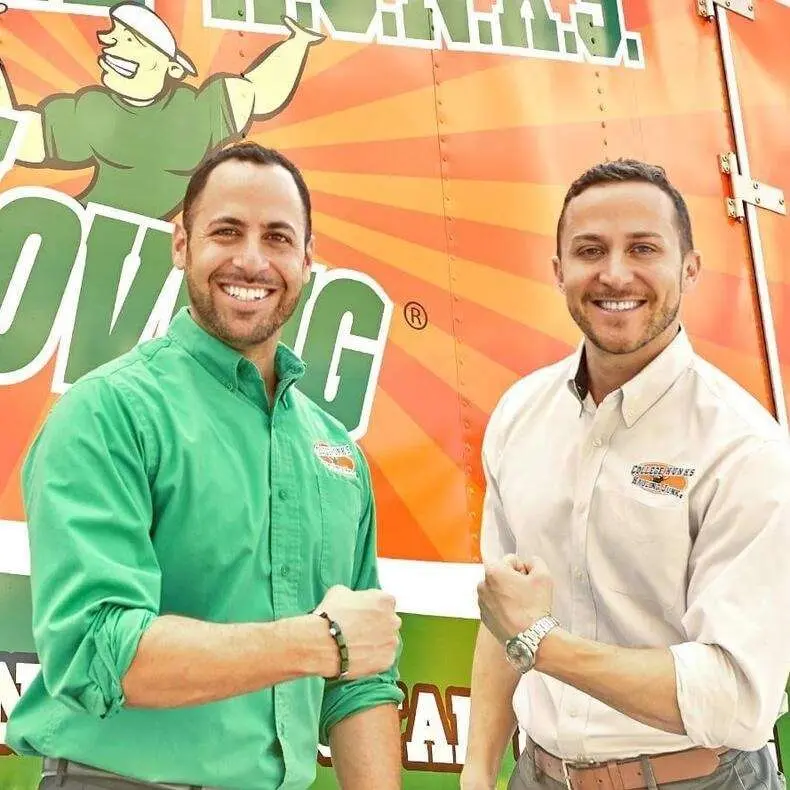
Nick Friedman and Omar Soliman borrow a cargo van and start hauling junk between college classes in Washington, D.C.
College HUNKS Hauling Junk officially incorporates. Moving services added to create the dual-revenue model.
Franchise operations launch. The first franchise locations open and the national expansion begins.
HOW A SIDE GIG BECAME A SYSTEM.
The College HUNKS story isn’t a Silicon Valley origin myth. It’s two guys who saw a broken industry and built something better, one truck at a time.
It started the way most good ideas start: out of frustration. Nick Friedman and Omar Soliman were college students in the early 2000s, watching friends and family dread every interaction with moving companies. Late arrivals. Damaged furniture. Zero accountability. They figured they could do better with a borrowed cargo van and a willingness to actually show up on time.
THE EARLY DAYS
What began as a way to make money between classes turned into something bigger. Customers kept calling back. Not because the rates were lower, but because the experience was different. The crews were polite. They wore uniforms. They treated people’s belongings like they mattered.
Nick and Omar realized they hadn’t just started a moving company. They’d stumbled onto a brand insight: in an industry with rock-bottom expectations, basic professionalism was a competitive advantage.
Building the system
They incorporated as College HUNKS Hauling Junk in 2004 and added local moving as a second service line. The dual-revenue model solved a problem that plagued every seasonal service business: downtime. Junk removal filled the gaps between moves. Moving anchored the revenue during peak season. Together, they created year-round demand.
THE FRANCHISE DECISION
In 2007, Nick and Omar made the leap from operators to franchisors. The logic was simple: the system they’d built worked, and it worked because it was a system, not a personality. The playbook, the training, the tech stack, the call center, the culture framework. All of it could be taught to the right person in the right market.
The first franchise locations proved the thesis. Owners who followed the system hit benchmarks. Owners who leaned into the H.U.N.K.S. culture outperformed. The model scaled because the infrastructure was there before the trucks were.
“We didn’t franchise a moving company. We franchised a system that happens to move things.”
WHERE IT STANDS TODAY
370+ locations across the United States. Over 20,000 jobs completed every month. A Franchise Times Top 400 brand and the 2026 Top Junk Removal Franchise. And still headquartered in Tampa, where the co-founders remain involved in operations, training, and franchise development.
The cargo van is gone. The principle behind it isn’t.
How the franchise works.
Two revenue streams, one set of operating costs, and a system that runs the business for you.
Franchisees talk about what the system actually looks like from the inside.
The story’s still being written.
New territories are opening across the country. Book a call to find out if your market is available.