
Nobody can honestly tell you what franchise owners make, and the pages that give you a confident number are usually answering a different question than the one you asked. Most of them quote gross revenue, which is what the business takes in, and present it as though it were owner income, which is what lands in your account after everyone else is paid. Those two numbers are not close to each other.
Here is what a franchisor is actually allowed to tell you, what College Hunks Hauling Junk® franchise locations reported in the most recent disclosure, and how to pressure-test any earnings figure you come across, including ours.
Why can’t anyone tell you what franchise owners make?
Because federal law is specific about it. Under the FTC Franchise Rule, a franchisor may only make a financial performance representation if that representation appears in Item 19 of its Franchise Disclosure Document, and any version of it used in marketing has to carry the same disclosures. A franchisor is not permitted to hand you a projection of what you personally will earn.
Franchisors are also not required to publish an Item 19 at all. Some skip it entirely. When a brand has no Item 19, any earnings number a salesperson quotes you is one you should not rely on.
And there is a second limit that gets glossed over constantly: most Item 19 disclosures report gross sales at the location level. They do not report what the owner took home, because the franchisor does not control the owner’s labor costs, fuel, insurance, debt service, or how many hours the owner works in the business instead of hiring it out. Two owners with identical revenue can end the year in completely different financial positions.
What is the difference between franchise revenue and owner income?
Gross sales is the total a location bills its customers in a year. Owner income is what remains after the cost of delivering that work, the fees owed to the franchisor, and any loan payments on the money used to open. The gap between the two is the entire business.
Three things sit between the two numbers, and only one of them is published in advance:
- Contractual fees. Disclosed in the FDD, identical for every owner, knowable before you sign.
- Operating costs. Labor, fuel, vehicle maintenance, insurance, rent. Market-specific and operator-specific.
- Financing. What you borrowed and on what terms.
Any article that gives you a single national figure for “franchise owner salary” is quietly assuming answers to all three. Treat that number as trivia, not planning material.
What comes out of gross sales before an owner pays themselves?
This is the part most comparison articles leave out, and it is the part you can actually verify. For a College HUNKS franchise, the ongoing obligations are disclosed in Items 5, 6, 7, and 11 of the 2026 Franchise Disclosure Document:
| Obligation | Amount |
|---|---|
| Initial franchise fee, single concept | $35,000 |
| Initial franchise fee, both concepts bought together | $65,000 |
| Qualified U.S. veteran discount | −$7,500 |
| Continuing royalty, in-territory gross sales | 7% |
| Continuing royalty, gross sales outside your territory | 8% |
| Brand Development Fund | 2% |
| Technology fee | 1% |
| Required local advertising, monthly | Greater of 8% of gross sales or $1,500 per zone (moving) / $1,100 per zone (junk) |
| Total initial investment, both concepts | $193,100 to $345,500 |
Those percentages are contractual and they apply to gross sales, not to profit, which means they come off the top whether a given month was a good one or not. Everything else, the crews and the trucks and the insurance and the rent, is operator-specific, and no disclosure can tell you what yours will be. We are not going to do that arithmetic for you and call it income, because any answer we produced would be a guess dressed up as a disclosure.
What we can do is show you the revenue side exactly as it was reported.
What do College HUNKS franchise owners actually report?
Item 19 of the 2026 FDD reports gross sales for franchised locations grouped by how long they had been open. Of 165 total outlets at the end of 2025, 149 fell into the reporting population, or 90%. That population is 144 franchised locations plus five affiliate-owned ones; the table below covers the 144 franchised.
| Time open | Locations | Average gross sales | Median gross sales |
|---|---|---|---|
| 13 to 36 months | 25 | $730,493 | $691,222 |
| 37 to 60 months | 37 | $1,126,072 | $868,852 |
| 60+ months | 82 | $1,999,230 | $1,555,903 |
| All 144 franchised | 144 | $1,554,610 | $1,127,776 |
Read the cohorts before you read the headline. The $1,554,610 system average is real and it is the store-count-weighted average of those three groups, but it is carried by the 82 locations that have been open five years or longer. A location in its second year sits closer to the $730,493 average, and the median in that cohort is $691,222. If you are modeling your own first two years, the mature-location number is the wrong one to plan against.
Averages hide the spread, so read both. Across all 144 franchised locations the average was $1,554,610 while the median was $1,127,776, and the range ran from $295,134 at the low end to $10,862,580 at the high end. A small number of very large operators pull the average up, which is why the median is the more honest middle and why a range tells you more than any single figure.
Does how long you have been open change the answer?
It changes it more than almost any other variable in the disclosure. Across the three cohorts, average gross sales nearly tripled between the 13-to-36-month group and the 60+ group. Some of that is territory maturity, some is repeat customers and referral flywheel, and some is simply owners who bought additional zones over time.
That is the practical argument for judging a franchise on its ramp, not its ceiling. Ask any franchisor you are evaluating for the distribution by tenure, and if they only have a single blended average to give you, ask why.
How do you check any franchisor’s numbers yourself?
Three steps, in this order:
- Read Item 19 line by line. Look for the size of the reporting population against total outlets, whether the figures are gross sales or profit, whether medians are shown alongside averages, and which locations were excluded. Our plain-English guide to reading Item 19 walks through what each disclosure is and is not telling you.
- Check Item 20 for the outlet trend. Openings, closures, transfers, and terminations over three years say as much about owner outcomes as any revenue table.
- Call existing owners. Item 20 includes a contact list, and franchisors cannot script those conversations. Ask what they actually took home in year two, not what the location billed.
For a worked example, College Hunks vs 1-800-GOT-JUNK lines up both brands’ investment ranges and disclosure years side by side.
If a brand’s answers get vaguer as your questions get more specific, that is your answer.
Do women franchise owners report different results?
Item 19 does not break results out by owner demographics, so there is no disclosure-grounded answer to that question.
What does exist is satisfaction data. Franchise Business Review named College HUNKS a 2026 Top Franchise for Women, and that award is worth understanding correctly: it comes from independent surveys of existing franchise owners about their experience with training, support, leadership, and community. It is a satisfaction ranking, not an earnings ranking. Brands cannot buy or apply their way onto it, which is what makes it useful, but it does not tell you what anyone earned.
For the version of this that has a face on it, Erica Fine left a ten-year finance career at General Electric and opened her College HUNKS franchise in Arlington Heights as a single mom with two kids at home. She is now at seven zones and two offices in under four years, with a staff of 35 in her low season, and she is candid on the podcast about what the first years cost her at home before the business could run without her standing in it. That is a path, not a projection, and it is more useful than any average.
So is owning a franchise worth it?
That depends on inputs only you can supply: how much capital you can put at risk, how long you can go before the business pays you, and whether you would rather buy a system or build one. A franchise removes the question of what to do and replaces it with the question of how well you execute. The revenue tables above tell you what execution has looked like across 144 locations. They do not tell you what yours will look like.
If you want to run the numbers against a specific market, the honest next steps are the full investment breakdown, the qualification requirements, and a conversation with someone who can pull the territory data for your zip code.
Talk to the franchise development team, or see which territories are still available.
Frequently asked questions
How much do franchise owners make on average?
There is no reliable cross-industry average, because franchisors disclose gross sales at the location level rather than owner income, and only when they choose to publish an Item 19. For College HUNKS specifically, the 144 franchised locations reporting for 2025 averaged $1,554,610 in gross sales, ranging from an average of $730,493 for locations open 13 to 36 months to $1,999,230 for those open 60 months or more.
Is franchise revenue the same as franchise owner salary?
No. Revenue is what the location bills customers. Owner income is what remains after operating costs, franchisor fees, and debt service. Franchisor fees are disclosed in advance, but operating costs and financing vary by owner and market, so two locations with the same revenue can produce very different owner income.
Where can I find a franchise’s real earnings data?
Item 19 of the Franchise Disclosure Document. It is the only place a franchisor is legally permitted to make a financial performance representation. Check the size of the reporting population against total outlets, look for medians alongside averages, and read Item 20 for the outlet trend and the list of current and former owners you can call.
Why do franchise earnings vary so much by location?
Tenure is the largest disclosed factor. In the 2026 College HUNKS Item 19, average gross sales nearly tripled between the 13-to-36-month cohort and the 60+ month cohort. Market size, how many zones an owner holds, and how much of the work the owner does personally rather than hiring out all move the number as well.
Financial information shared in this content is drawn from Item 19 of the 2026 CHHJ Franchising, L.L.C. Franchise Disclosure Document (Issuance Date: April 30, 2026, as amended August 26, 2026). See Item 19 for material assumptions, the underlying data set, and full required disclosures. Past performance does not guarantee future results. New franchisees may earn less.
This information is not an offer to sell or solicitation to buy a franchise. A franchise offering can only be made through the delivery of a Franchise Disclosure Document. Certain states regulate the offer and sale of franchises; if you are a resident of one of these states, we will not offer you a franchise unless we have complied with applicable pre-sale registration and disclosure requirements in your state.
College Hunks Hauling Junk®, College Hunks Moving®, and the H.U.N.K.S logo are registered trademarks of CHHJ Franchising, L.L.C. © 2026 CHHJ Franchising, L.L.C. All rights reserved.

Twenty minutes with our team.
The model, the live territory map, and the unit economics for your market. No script, no pressure.
Qualifying veterans and first responders receive a discount on the initial franchise fee.
Could this be your story?
Book a call with the franchise development team. They’ll walk you through the model, the live territory map, and the unit economics for your market.
More from the newsroom.
Hand-picked from the same category. All stories →
-
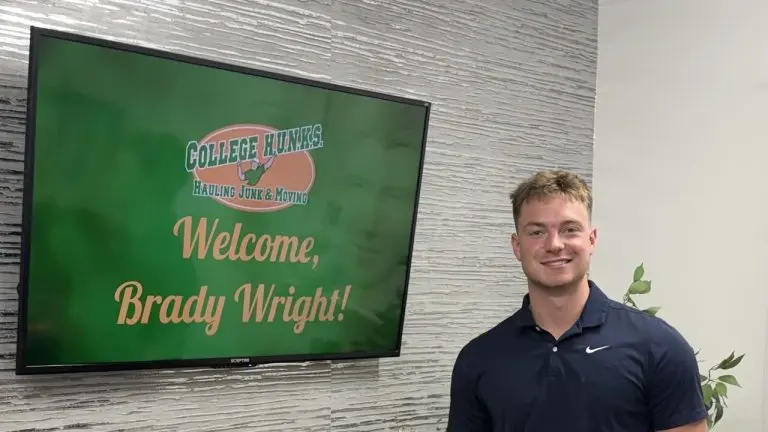
Brady Wright: IU Student to Bloomington College HUNKS Owner
IU student Brady Wright signed a College HUNKS franchise to open in Bloomington, Indiana, before graduating. How he got there and what he plans to build.
-
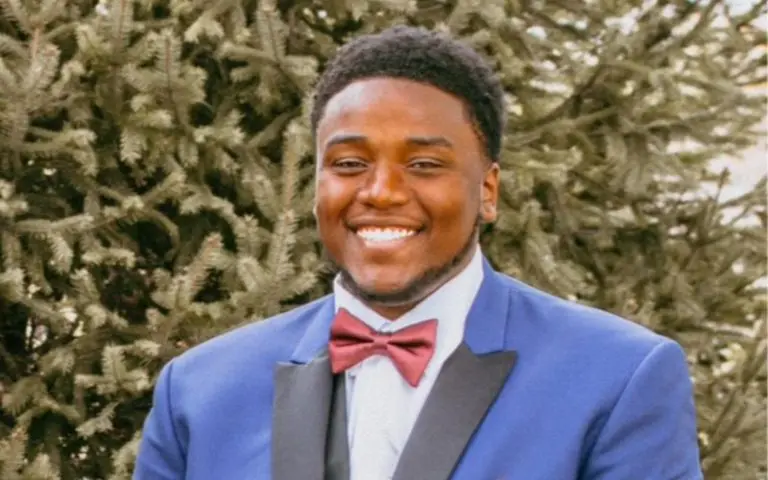
Meet Montez Miles: From Helper to College HUNKS Owner in Indianapolis
Montez Miles worked his way up from helper to operations manager at another mover. Now he’s bringing College HUNKS junk removal and moving to Indianapolis.
-
8 Self-Employment Ideas After 50 for 2026
Eight self-employment ideas for experienced managers over 50, compared by capital, time to first customer and fit, from consulting to a franchise.