Buying an existing franchise means purchasing an operating location from its current owner instead of opening a new one, and the trade is straightforward: you pay more upfront in exchange for revenue history you can read before you commit. A resale comes with customers, a trained crew, equipment in service, and a profit and loss statement showing what the business actually does rather than what a projection says it might do. It also comes with everything else the seller built, which is why diligence on a resale looks nothing like diligence on a new market.
What does buying an existing franchise actually mean?
Two transactions happen at once, and most first-time buyers prepare for one. The first is an ordinary business purchase between you and the selling owner: assets, vehicles, customer base, goodwill. The second is a franchise transaction, where the franchisor qualifies you exactly as it qualifies any new candidate, delivers a current Franchise Disclosure Document, and consents to the transfer before anything closes.
That second half is where deals slow down or die. A seller can agree to a price in a week; the brand still has to decide whether you are the right operator for a market it lives with for years. I sit on that side of the desk at College Hunks Hauling Junk®, and approval is not a formality.
What does a resale give you that a new location cannot?
Financial history for the exact market you are buying. A new location gives you a franchisor’s Item 19 averages plus your own assumptions; a resale gives you this store’s revenue by month, its average ticket, its call volume, and its real cost of doing business. That is a different starting point for a lender and for your own decision.
- Revenue on day one. The phones are ringing and the jobs are booked, so you are not funding a ramp from zero.
- A crew that knows the work. Hiring and training a service team is the slowest part of opening.
- Equipment in service. Trucks are wrapped, insured, and running routes rather than sitting on order.
- A reputation you can measure. Reviews, repeat customers, and referrals are visible before you buy.
What are the tradeoffs of buying a resale?
You pay for the history and inherit the seller’s decisions with it. A resale is priced on earnings the business already produces, so the price typically lands well above the same brand’s new-unit investment range, and you take on the previous owner’s hiring standards, deferred maintenance, reviews, and standing with the franchisor.
| Dimension | New location | Resale |
|---|---|---|
| Upfront cost | The disclosed initial investment range | Negotiated on earnings, usually higher |
| Financial visibility | Item 19 averages plus assumptions | This location’s actual books |
| Time to revenue | Months of buildout and ramp | Day one |
| Team | You hire and train | Inherited, for better or worse |
| Local reputation | You create it | You inherit it, reviews included |
| Agreement term | Full initial term | Often the seller’s remainder |
| Financing | Startup lending | Acquisition lending |
How is a franchise resale valued?
Almost always as a multiple of adjusted earnings, not a multiple of revenue. Buyer and seller agree on what the business truly earns for an owner once the books are normalized, then apply a market multiple. Normalizing means adding back one-time and personal costs the seller ran through the business, and subtracting anything they were not paying that you will have to, such as a market-rate manager if the seller ran the counter.
What moves the multiple is boringly practical: tenure, whether earnings are trending up or down, how much revenue depends on the departing owner personally, the condition of the fleet, and how much term is left on the agreement.
A franchisor’s Item 19 is a sanity check on a resale, never a valuation. It tells you whether the asking earnings are plausible for a location of that tenure. In the College Hunks system, the 2026 Franchise Disclosure Document reports average gross sales by how long a location has been open:
| Tenure | Locations reporting | Average gross sales | Median gross sales |
|---|---|---|---|
| 13 to 36 months | 25 | $730,493 | $691,222 |
| 37 to 60 months | 37 | $1,126,072 | $868,852 |
| 60+ months | 82 | $1,999,230 | $1,555,903 |
Read the gap between the averages and the medians first. The spread inside each cohort is wide, which is why a resale’s own books matter more than any system-wide figure. We walk through the Item 19 revenue picture separately.
What does the franchise resale process look like?
The sequence is consistent enough across brands that knowing it keeps you from spending out of order.
- The location comes to market, through a broker, quietly through the franchisor, or because a neighbor is circling it.
- You qualify with the franchisor, on the same screen as a new candidate, ideally before you pay for an appraisal.
- You receive a current Franchise Disclosure Document. The agreement you sign is today’s, not the one the seller signed, so read Item 6 and Item 17 closely.
- You do diligence: books, tax returns, payroll, fleet, contracts, and the reason for the sale.
- You sign a purchase agreement conditioned on franchisor approval. Never sign one that is not.
- The franchisor consents and you complete training, which most systems require regardless of prior experience.
Two items surprise buyers. Many franchise agreements give the franchisor a right of first refusal, meaning the brand can step into your negotiated deal on the same terms. And the transfer fee sits in Item 6, so know that number before you agree on a price.
What should you check before you sign?
The financials are the obvious part. These are the ones buyers skip:
- Why the owner is selling. Retirement and relocation read very differently from a market that stopped working.
- Remaining term and renewal rights. Three years left is a different purchase than twelve.
- The owner’s standing with the franchisor. Ask about open default notices, unpaid fees, or compliance issues you would inherit.
- Customer concentration. A location leaning on two commercial accounts is fragile in a way a broad residential book is not.
- Who actually runs the place. If the general manager is the reason it works, find out whether they stay.
How does a resale work in the College Hunks system?
College Hunks Hauling Junk® and College Hunks Moving® are sold by zone, a zone covers a population of roughly 300,000 to 400,000, and about 70% of the system owns more than one territory. That cuts two ways for a resale buyer: existing owners are often the competing bidders, and a resale can be a practical way into a system where the strongest markets were claimed years ago.
The ongoing economics are identical whether you buy a location or open one. Royalty runs 7% of gross sales (8% outside the Designated Territory), plus a 2% brand development fee and a 1% technology fee. Appointments booked through the national Sales and Loyalty Center carry a 6% fee on junk removal and 5% on moving, with no fee on self-generated or online-booked sales. Local advertising is the greater of 8% of gross sales or $1,500 per zone monthly for moving and $1,100 per zone for junk. Those are the same figures in the full investment breakdown.
On the other path, a new combined junk and moving location in one zone carries a $65,000 initial franchise fee inside a total estimated initial investment of $193,100 to $345,500, against a net worth requirement of $200,000, with $3,750 off the fee per concept for qualified veterans, or $7,500 for both concepts holding 51% or greater ownership. Either route gets the same dedicated Marketing Coach and Franchise Business Coach, and you can see the training and support owners get first. If capital is your constraint, a new location lets you build at the disclosed range; if you have the capital and want revenue and a team from week one, a resale buys you both. If you have not settled on franchising at all yet, buying a franchise vs starting a business is the earlier decision worth making first.
If you are weighing a College Hunks franchise, resale or new market, talk to our Franchise Development team and we will tell you honestly what the picture looks like today. You can also see if your market is still open. We read every inquiry, no pressure, just answers.
Financial information shared in this content is drawn from Item 19 of the 2026 CHHJ Franchising, L.L.C. Franchise Disclosure Document (Issuance Date: April 30, 2026, as amended August 26, 2026). See Item 19 for material assumptions, the underlying data set, and full required disclosures. Past performance does not guarantee future results. New franchisees may earn less.
This information is not an offer to sell or solicitation to buy a franchise. A franchise offering can only be made through the delivery of a Franchise Disclosure Document. Certain states regulate the offer and sale of franchises; if you are a resident of one of these states, we will not offer you a franchise unless we have complied with applicable pre-sale registration and disclosure requirements in your state.
College Hunks Hauling Junk®, College Hunks Moving®, and the H.U.N.K.S logo are registered trademarks of CHHJ Franchising, L.L.C. © 2026 CHHJ Franchising, L.L.C. All rights reserved.

Twenty minutes with our team.
The model, the live territory map, and the unit economics for your market. No script, no pressure.
Qualifying veterans and first responders receive a discount on the initial franchise fee.
Could this be your story?
Book a call with the franchise development team. They’ll walk you through the model, the live territory map, and the unit economics for your market.
More from the newsroom.
Hand-picked from the same category. All stories →
-
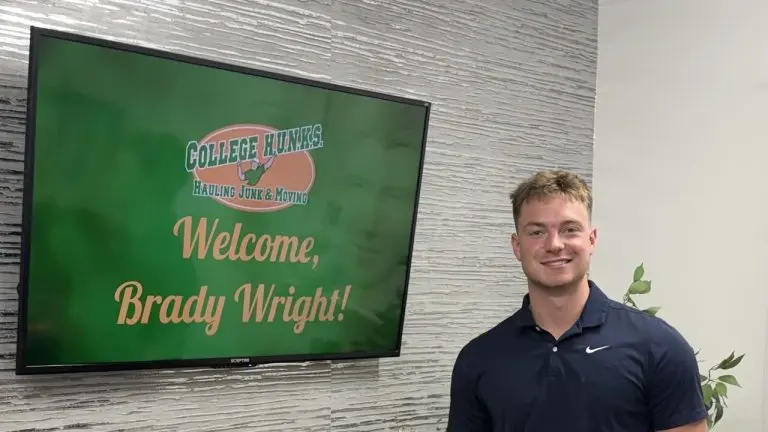
Brady Wright: IU Student to Bloomington College HUNKS Owner
IU student Brady Wright signed a College HUNKS franchise to open in Bloomington, Indiana, before graduating. How he got there and what he plans to build.
-
Meet Montez Miles: From Helper to College HUNKS Owner in Indianapolis
Montez Miles worked his way up from helper to operations manager at another mover. Now he’s bringing College HUNKS junk removal and moving to Indianapolis.
-
8 Self-Employment Ideas After 50 for 2026
Eight self-employment ideas for experienced managers over 50, compared by capital, time to first customer and fit, from consulting to a franchise.