
Franchise owner responsibilities fall into three groups: what you owe the franchisor under the franchise agreement (fees, brand standards, reporting, and running the business yourself), what you owe the business as its operator (hiring, scheduling, the numbers, and the customer experience), and what you owe the people you hire. The agreement spells out the first group in detail. The other two are the actual job.
I read franchise agreements for a living, and the question behind this search is usually simpler than it looks: “What am I committing to, and what does the franchisor commit to in return?” This post answers both, using the 2026 College Hunks Hauling Junk® Franchise Disclosure Document (FDD) as the worked example. A franchise disclosure document organizes a brand’s obligations into 23 numbered Items, so I will point to the Item each responsibility lives in.
What are a franchise owner’s responsibilities to the franchisor?
A franchise owner’s responsibilities to the franchisor are contractual: pay the ongoing fees on time, operate to the brand’s standards, report sales accurately, carry the required insurance, complete training, protect the trademarks, and run the business personally. Every one of those is written into the franchise agreement, and the FDD tells you where to look before you sign anything.
Here is how those obligations map to the FDD for a College HUNKS owner.
| Responsibility | What it means in practice | Where it is defined |
|---|---|---|
| Pay ongoing fees | A 7% royalty, a 2% brand development fee, and a 1% technology fee on gross sales, plus a local advertising commitment and Sales & Loyalty Center appointment fees | Items 6 and 11 |
| Operate to brand standards | Uniforms, branded trucks, safety practices, and customer experience standards | Item 11 and the operations manual |
| Report and allow review | Accurate sales reporting through the system’s technology, and access for the franchisor to review records | Items 6 and 11 |
| Complete training | Roughly 5 to 15 days of initial training for up to two management personnel, plus ongoing refreshers | Item 11 |
| Run it yourself | College HUNKS is an owner-operator model; the owner leads the business day to day | Item 15 |
| Protect the marks | Use the trademarks only as licensed, and keep system information confidential | Items 13 and 14 |
| Honor the term | A 10-year initial term with a 10-year renewal option, and franchisor approval before any transfer | Item 17 |
Owners take on real obligations, including a local advertising commitment and Sales & Loyalty Center appointment fees. Both are set out in Items 6 and 11 of the FDD, and the franchise development team walks through each one with you. We have also written up what a franchise owner pays on an ongoing basis and what those royalties actually fund.
If that table reads like a job you would want, the next step is a conversation. Talk to the franchise development team and we will walk you through the actual agreement, clause by clause.
What does a franchise owner do day to day?
Day to day, a franchise owner hires and leads the crew, keeps the trucks and the calendar full, watches the numbers, and owns the customer experience. The franchisor supplies the system, the brand, and the support; the owner supplies the leadership that turns those into a running business.
For a College HUNKS owner, that work splits into four lanes:
- People. Recruiting, training, and coaching the crew customers will trust in their homes, which is why we recruit leaders rather than laborers.
- Operations. The daily huddle, the day’s jobs, vehicle compliance, and the standards on every job.
- Numbers. Revenue, job margin, labor cost, and cash. The technology stack reports it; the owner acts on it.
- Customers and community. Reviews, referral sources, and the local marketing the brand’s playbook expects.
We walk through a typical morning, midday, afternoon, and evening on our day in the life of a College HUNKS franchise owner page. The owner’s day starts with the team and ends with the numbers.

What is the franchisor responsible for in return?
The franchisor is responsible for the system: the brand, the initial and ongoing training, the technology, the national booking engine, and the coaching. In the College HUNKS model that means a National Sales & Loyalty Center that takes customer calls, schedules appointments, and routes jobs to owners by zip code, plus a Marketing Coach and a Franchise Business Coach assigned to each owner.
Those obligations are spelled out in Item 11 of the FDD, and they are the half of the relationship most buyers forget to audit. Read Item 11 as carefully as you read Item 6, because a franchisor’s responsibilities are only worth what the contract requires them to deliver. Our training and support program page lists what the program covers; the FDD is where you verify it.
What is a person who owns a franchise called?
A person who owns a franchise is called a franchisee. The company granting the license is the franchisor. In most service brands, including ours, you will also hear “franchise owner” and “owner-operator,” which describes a franchisee who runs the business personally rather than through a hired general manager. We use “owner.” It is the accurate word for someone who signs a 10-year agreement, invests their own capital, and leads a team.
What are two disadvantages of owning a franchise?
The two disadvantages of owning a franchise are the ongoing fees and the loss of some independence. You pay a share of gross sales for as long as you hold the license, and you agree to run the business the brand’s way, from the truck wrap to the uniform. For some operators those are deal-breakers, and I would rather say so plainly than pretend otherwise.
The counterweight is what the fees and the standards buy. An independent hauler or mover has to build demand, a booking function, a brand, and a playbook from zero, and many stall on demand. A College HUNKS owner starts with a national brand, a booking center routing jobs to their zip codes, and two coaches. Whether that trade is worth it depends on how much you value speed and support over total control. We compared the two paths honestly in buying a franchise vs starting a business.
Do franchise owners make a lot of money?
Some franchise owners make a lot of money and some do not, and the only honest answer lives in Item 19 of the brand’s FDD. Under the Federal Trade Commission’s Franchise Rule (16 CFR Part 436), Item 19 is the one place a franchisor may make a financial performance representation, so treat any earnings claim made outside it as a red flag.
For College HUNKS, Item 19 of the 2026 FDD reports an average gross revenue of $1,554,610 across 144 franchised locations in 2025, with locations open more than 60 months averaging $1,999,230 across 82 locations. The EBITDA figures in the same Item exclude truck payments and owner compensation, so read the definitions before you model your own take-home. The full tenure tables, averages and medians, are on our Item 19 revenue picture page. What those numbers cannot tell you is whether a specific owner, in a specific market, will match them, and a responsible franchisor will never claim they do.
What happens when an owner cannot meet their obligations?
The franchise agreement defines what counts as a default, how long the owner has to cure it, and what happens if they cannot. It also covers the transitions nobody plans for. In the College HUNKS agreement, if an owner dies or becomes disabled, the business has 90 days to get a qualified new manager through training, and a transfer to a new owner requires franchisor approval and a transfer fee of $15,000 for the first zone and $5,000 for each additional zone (Items 6 and 17).
None of that is unusual, and all of it is worth reading before you sign, because those clauses define the real exit value of what you are building. Our guide to what is included in a franchise agreement walks through the clauses that deserve the most attention.
How do franchise owner responsibilities change as you grow?
As an owner adds zones, the responsibilities shift from running jobs to leading managers. In the first zone the owner is in the huddle every morning. By the second or third, the owner’s job is hiring and developing the people who run those huddles, reading three sets of numbers instead of one, and keeping the culture consistent across trucks they do not personally see. Our post on multi-unit franchise ownership covers how owners sequence that growth. The initial responsibilities are learnable in training; the leadership responsibilities decide how far the business goes.
Ready to see the actual list?
Every responsibility above has a clause behind it, and the only version that matters is the one in the document you would sign. If you are weighing whether a College Hunks Hauling Junk® franchise fits your goals, talk to our franchise development team and see if your market is still open. We read every inquiry and there is no pressure, just answers.
Disclosures
Financial information shared in this content is drawn from Item 19 of the 2026 CHHJ Franchising, L.L.C. Franchise Disclosure Document (Issuance Date: April 30, 2026, as amended August 26, 2026). See Item 19 for material assumptions, the underlying data set, and full required disclosures. Past performance does not guarantee future results. New franchisees may earn less.
This information is not an offer to sell or solicitation to buy a franchise. A franchise offering can only be made through the delivery of a Franchise Disclosure Document. Certain states regulate the offer and sale of franchises; if you are a resident of one of these states, we will not offer you a franchise unless we have complied with applicable pre-sale registration and disclosure requirements in your state.
College Hunks Hauling Junk®, College Hunks Moving®, and the H.U.N.K.S logo are registered trademarks of CHHJ Franchising, L.L.C. © 2026 CHHJ Franchising, L.L.C. All rights reserved.

Real answers from our team.
The model, the live territory map, and the unit economics for your market. No script, no pressure.
Qualifying veterans and first responders receive a discount on the initial franchise fee.
Could this be your story?
Book a call with the franchise development team. They’ll walk you through the model, the live territory map, and the unit economics for your market.
More from the newsroom.
Hand-picked from the same category. All stories →
-
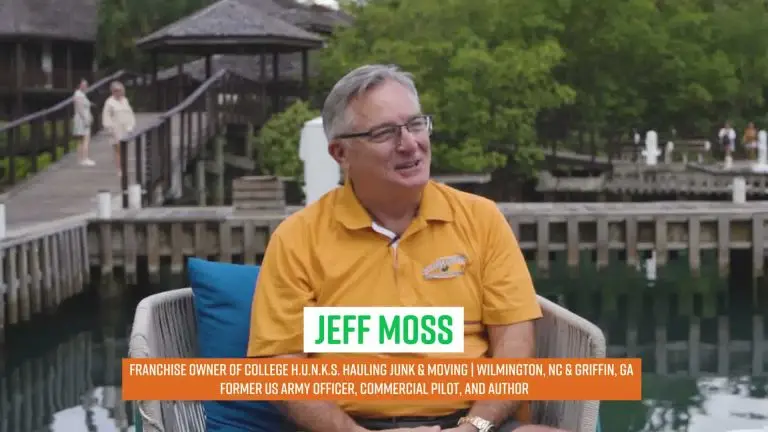
Army Pilot to Franchise Owner: The Jeff Moss Story
Bronze Star Army veteran Jeff Moss tells Nick Friedman how combat leadership shapes the crews at his College HUNKS franchises in Wilmington, NC and Griffin, GA.
-
Types of Franchises: 5 Models Explained (2026)
The types of franchises explained: business format, product distribution, manufacturing, conversion and master deals, with a side-by-side table.
-
Franchise Business Plan: What Lenders Want to See
A franchise business plan uses the nine standard sections. See which FDD Items feed each one, what lenders check, and who writes the projections.