The junk removal marketing strategies that keep a schedule full are local search visibility (a Google Business Profile plus steady review velocity), paid search aimed at same-day intent, route-density targeting so jobs cluster, repeat commercial accounts, and branded trucks working as rolling signage. One of those wins a first customer. Four or five running together keep a truck moving on days it would otherwise sit.
That gap between “I got a job” and “I stay booked” is where most independent haulers stall. Getting the phone to ring once is a weekend of flyers. Getting it to ring every Tuesday in February is a system. Here is what each piece buys you, and what changes when a central Sales and Loyalty Center books jobs by zip code for you.
What do junk removal marketing strategies actually have to do?
They solve three problems at once: visibility (someone in your service area has to find you), timing (junk removal is a near-instant-need purchase, so the winner is usually whoever shows up first in the moment), and geography (a job 40 minutes from your last one costs an hour of unpaid drive time).
Most marketing advice only solves the first. A beautiful website with no local search presence reaches people who already know your name, which is nobody in month one. The channels below are ranked by how directly they solve all three.
How do you win local search for junk removal?
Local search for junk removal comes down to a complete Google Business Profile, a steady flow of recent reviews, and service-area pages naming the towns you actually cover. The map pack sits above organic results for almost every “junk removal near me” search, so a profile that ranks there beats a website that ranks below it. Google says it weighs relevance, distance, and prominence when it orders those results (see how Google determines local ranking).
- Review velocity, not review count. Twelve reviews across the last three months outperform sixty from 2022.
- Photos on every job. Recent before-and-after shots signal an active business.
- Service areas that match reality. Listing 30 towns you will not drive to dilutes relevance for the 8 you will.
This is slow, compounding work that costs time rather than money, which makes it the right first channel for an operator whose capital is tied up in a truck. A College HUNKS owner works through it with coaching instead of starting from a blank page.
Which paid junk removal marketing strategies are worth the money?
Paid search and Local Services Ads earn their keep because junk removal buyers search with urgency and convert fast. Social display advertising earns much less, because nobody scrolling a feed decides to empty a garage that afternoon.
| Channel | What it buys you | Speed to first job | Best for |
|---|---|---|---|
| Google Business Profile and reviews | Map pack visibility on high-intent local searches | Weeks to months | Every operator, from day one |
| Local Services Ads | Top-of-page placement, pay per qualified lead | Days | Filling open capacity fast |
| Paid search | Same-day intent keywords in your zip codes | Days | Controlling which towns call you |
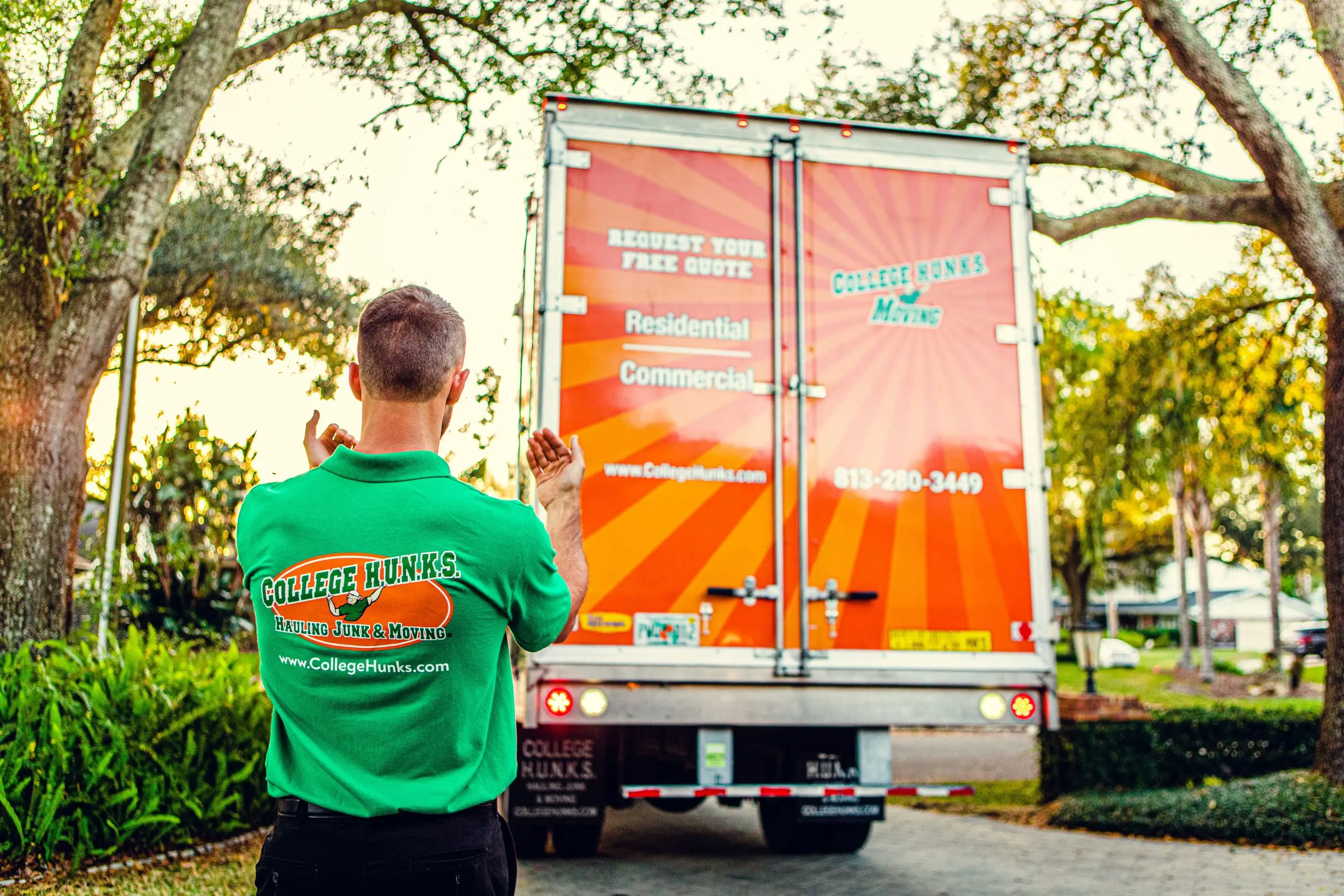
| Truck wraps and uniforms | Repeated local impressions at zero marginal cost | Months | Route density and referrals |
| Commercial and property-manager outreach | Repeat accounts and scheduled volume | Weeks to months | Smoothing seasonal dips |
| Paid social display | Brand awareness only | Rarely direct | Operators with budget left over |
None of these belong in a plan as a single line that says “marketing.” When you build the financial section of your junk removal business plan, each channel needs its own monthly number and its own expectation.
How does route density change what you should market?
Route density is why two operators with identical revenue can post very different margins. A truck doing four jobs inside a six-mile radius bills the same as a truck doing four across a county, and the second burns two extra hours of labor and fuel.
That makes geography a marketing decision: concentrate spend and review-building where you can serve tightly, and price the outer edge of your radius to reflect the drive. Building a junk removal pricing sheet and drawing a service map are the same exercise from two directions. For a College HUNKS owner, the Sales and Loyalty Center routes booked jobs by zip code, so work arrives already sorted to the territory.
How do you build repeat and commercial revenue?
Repeat revenue in junk removal comes from the people who create junk on a schedule: property managers turning units, real estate agents clearing listings, contractors on renovation cycles, storage facilities handling abandoned units, and estate attorneys managing cleanouts.
A residential job is one great afternoon and then silence for four years. A property management company with 300 units is a standing appointment. Winning those accounts is relationship work more than advertising. Operators who survive a first slow winter often have two or three of them carrying the floor. College HUNKS owners also have a National Accounts program that connects multi-location commercial clients with local owners.
What should an independent operator budget for marketing?
There is no responsible single number, because it moves with market size, competition, and how fast you want to fill capacity. What stays consistent is the shape of the budget. The common mistake is treating marketing as what is left over after a slow month rather than a fixed cost committed to before the month starts.
Set the number the way you would set a truck payment, split it between a fast channel and a slow one, and judge each by cost per booked job rather than cost per click. Cheap clicks that turn into expensive jobs are the quietest way a small operator loses money.
What does a franchise marketing engine replace?
A franchise replaces the parts of the demand system an independent has to build alone, which is most of them. With College Hunks Hauling Junk®, the national Sales and Loyalty Center books thousands of jobs a week and routes them by zip code, so an owner leads a crew instead of answering a phone at 7pm. Every owner also gets a dedicated Marketing Coach alongside a Franchise Business Coach for the life of the franchise, which is the difference between guessing at channel mix and having someone who has watched it work across more than 150 locations. What that demand engine produces at the location level is laid out in the Item 19 revenue picture, and the same shift applies to moving company marketing for owners who run both concepts.
| Demand function | Independent operator | College Hunks franchise owner |
|---|---|---|
| Brand recognition | Built town by town over years | Approximately $30M in annual national media exposure |
| Call handling and booking | The owner, or a missed call | National Sales and Loyalty Center, thousands of jobs booked weekly |
| Channel strategy | Self-taught, trial and error | Dedicated Marketing Coach for the life of the franchise |
| Second revenue line | Junk removal only | Junk removal and College Hunks Moving® under one brand, in one territory |
| National and commercial accounts | Prospected one at a time | A National Accounts program that connects multi-location commercial clients with local owners |
Ask the franchise development team what the Sales and Loyalty Center books in a market like yours.
None of that is free, and the support structure owners get comes with real obligations, including a local advertising commitment and Sales and Loyalty Center appointment fees. Both are set out in Items 6 and 11 of the FDD, and the franchise development team walks through each one on a call.
Should you build the demand or buy it?
Build it if you have runway, patience, and a market where you can out-review the competition before your savings run out. Grinding out local search behind your own truck is a legitimate path, and the whole approach is worth reading through in how to start a junk removal business.
Buy it if marketing and booking are the parts you least want to own, and you would rather have a central Sales and Loyalty Center taking calls and booking jobs by zip code while you lead the crew. Operators already running an independent hauling business have their own path: they can convert an independent junk business into a franchise, keep the book of business they built, and stop competing against a brand they could be running instead.
Frequently asked questions
What is the fastest way to get junk removal customers?
Local Services Ads and paid search produce booked jobs within days, because both put you in front of people searching with same-day intent. They cost money per lead, so treat them as capacity fillers rather than a permanent foundation.
Do junk removal businesses need a website to get customers?
A website helps, but a complete Google Business Profile with recent reviews and job photos matters more. The map pack sits above organic results for most local junk removal searches, so profile quality outranks site design for booked jobs.
How many reviews does a junk removal business need to rank locally?
There is no threshold number. Recency and consistency matter more than total count, so a steady flow of new reviews each month generally outperforms a larger set that has gone stale.
Is commercial junk removal work better than residential?
Commercial accounts deliver repeat, schedulable volume that smooths seasonal dips, while residential jobs typically carry higher per-job margins and no relationship to maintain. Most stable operators run both.
Talk it through with the team
If you are running a hauling business and marketing has become the hardest part of the week, that is worth a conversation. Talk to the franchise development team and ask what the demand engine actually does for an owner in a market like yours, or see if your market is still open. We read every inquiry and there is no pressure, just answers.
Disclosures
Financial information shared in this content is drawn from Item 19 of the 2026 CHHJ Franchising, L.L.C. Franchise Disclosure Document (Issuance Date: April 30, 2026, as amended August 26, 2026). See Item 19 for material assumptions, the underlying data set, and full required disclosures. Past performance does not guarantee future results. New franchisees may earn less.
This information is not an offer to sell or solicitation to buy a franchise. A franchise offering can only be made through the delivery of a Franchise Disclosure Document. Certain states regulate the offer and sale of franchises; if you are a resident of one of these states, we will not offer you a franchise unless we have complied with applicable pre-sale registration and disclosure requirements in your state.
College Hunks Hauling Junk®, College Hunks Moving®, and the H.U.N.K.S logo are registered trademarks of CHHJ Franchising, L.L.C. © 2026 CHHJ Franchising, L.L.C. All rights reserved.

Twenty minutes with our team.
The model, the live territory map, and the unit economics for your market. No script, no pressure.
Qualifying veterans and first responders receive a discount on the initial franchise fee.
Could this be your story?
Book a call with the franchise development team. They’ll walk you through the model, the live territory map, and the unit economics for your market.
More from the newsroom.
Hand-picked from the same category. All stories →
-
Brady Wright: IU Student to Bloomington College HUNKS Owner
IU student Brady Wright signed a College HUNKS franchise to open in Bloomington, Indiana, before graduating. How he got there and what he plans to build.
-
Meet Montez Miles: From Helper to College HUNKS Owner in Indianapolis
Montez Miles worked his way up from helper to operations manager at another mover. Now he’s bringing College HUNKS junk removal and moving to Indianapolis.
-
8 Self-Employment Ideas After 50 for 2026
Eight self-employment ideas for experienced managers over 50, compared by capital, time to first customer and fit, from consulting to a franchise.