Franchisee stories · Hunks Talking Junk, Ep. 4
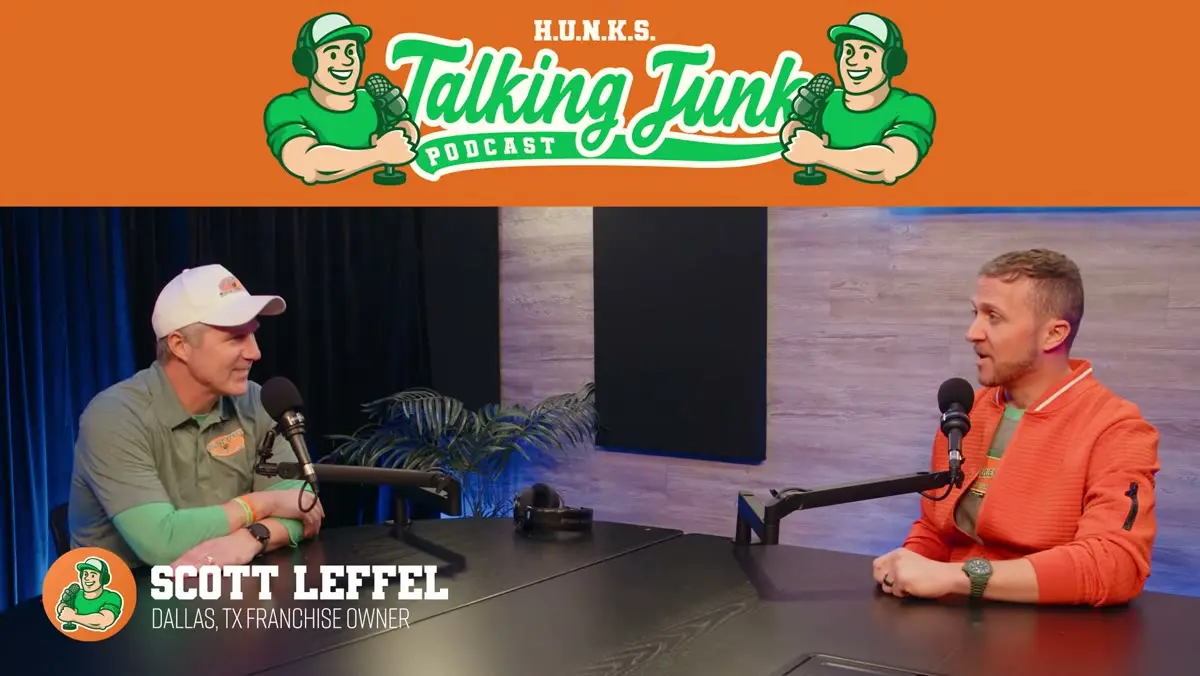
Scott Leffel owns the College Hunks Hauling Junk® franchise serving Dallas, Texas, and he bought it at 50 years old, out of a corporate sales job, in the middle of COVID. He had owned a franchise before and it went badly. He looked for more than a year and went through roughly a hundred business plans before he picked this one. Then he set the first-year performance record for any franchise entering the system, and five years later he set another one, which is what put co-founder Nick Friedman on a plane to Dallas to record Episode 4 of Hunks Talking Junk.
The episode runs about 41 minutes and it is unusually candid about cost. Scott did not take a paycheck for a year and a half. His wife carried the household. He names his single biggest mistake without being asked twice. If you are sitting in a corporate job doing this math yourself, his path is the one on this podcast that most resembles yours. It pairs well with Erica Fine’s episode, another corporate exit, and with the Thomas brothers’ episode, which is the same climb starting from the truck.
Who is Scott Leffel?
Scott Leffel is the owner of the College HUNKS Hauling Junk & Moving franchise serving Dallas, Texas, and one of the top-performing owners in the system. He came out of the corporate world rather than the trades. He was a sales director in the restaurant delivery technology sector at a NASDAQ-listed company that was going through heavy turnover while its stock price fell, and at 50 he read the situation for what it was.
He had owned businesses before, including one franchise that left a mark. That brand’s ownership group was on its way out and had stopped reinvesting, something he only found out after he had signed. So when he started looking again, he knew exactly what to check: who owns the brand, where they are headed, and what the existing owners say when nobody from corporate is in the room. He worked the validation calls hard, and the answers he got are what closed him.
He had actually already signed with a different franchise when College HUNKS came across his desk. The name got his attention, the way it does for most people, and the business underneath it held up to a year of due diligence.
Is junk removal and moving a recession-resistant business?
Scott’s case for it is that the work cannot be automated away and does not stop when money gets tight, which is the test he applied after watching a tech company come apart around him. He was evaluating during COVID, when moving and hauling were classified as essential, so he got to watch the industry hold up under the worst conditions available before he wrote a check.
“This is pretty much a technology proof business. It’s inflation proof. It’s recession proof, interest rate proof really. And so that just checked a lot of boxes.”
Scott Leffel
That framing is worth borrowing whether or not this brand ends up being the one. Anyone comparing which franchise is worth owning is really asking what happens to the demand in a bad year, and service work that people cannot do themselves tends to answer that question better than most categories do.
How did Scott Leffel set a first-year record?
He built for the business he intended to have rather than the one he was opening with, and he funded that gap out of savings instead of revenue. His goal was never a five hundred thousand dollar business or a one million dollar business, so none of his early decisions were sized for one. The clearest example is how he set his marketing budget: not against current revenue, but against the revenue he was aiming at.
The part most people cannot copy without planning for it is the cash. He went 18 months without paying himself, and everything the business generated went back into the business.
“I didn’t take a paycheck for 18 months, and not everybody can do that. Luckily my wife worked and so she was helping pay the bills, and we didn’t live an extravagant lifestyle, but everything that we were doing for the first year and a half was just putting it all right back into the business.”
Scott Leffel
He is direct that this was a household decision, not an individual one. He and his wife hit their 30th anniversary this year, which means they were 25 years in when he resigned from a job that was paying well to buy a moving business. Her first reaction was to ask if he was serious. What got her there was the why, explained plainly: a short step backward to take three steps forward. Nick calls this the four Fs when he coaches candidates through it, meaning fit, family, financial, and fun, and family is the one that quietly decides most of these.
Scott also refuses to run the business alone. He sits on the franchise advisory council, hosts a certified training location for newer owners, and volunteers for pilot programs, and he is honest that the motive is self-interested.
“Half of the reason that I’m in the franchise is for the playbook and the support system… But what a lot of people take for granted is there’s 200 other franchise owners out there. And so what I try to tell anybody that’s new to the system is don’t put yourself on an island.”
Scott Leffel
What is the hardest part of scaling a franchise?
Hiring leaders, by his own account, and he says so without hedging. Scott names leadership hires as the single biggest mistake he has made since opening, and the reason he made it repeatedly is that he believes in promoting from within, so he kept betting on people before they were ready.
“Without question, the number one mistake that I’ve made over the time that we’ve been open is hiring leadership… just because somebody’s a great captain on a truck doesn’t mean that they’re going to be a great manager.”
Scott Leffel
He does the math out loud, and it is the most useful minute in the episode. A leadership hire takes about a month to source. Onboarding runs at least three months before the person knows the operation. Getting from running shifts to driving a program is another three. That is a six-month build, so a wrong pick costs closer to a year once you restart the whole thing.
His fix on the culture side came from his operations manager, Devonte Smith, who took the role during a stretch of heavy turnover and was given one assignment first: get the culture right. About 60 percent of the staff has now been there over a year. Scott runs on EOS, so the language is right person, right seat, and the standard is whether someone gets it, wants it, and has the capacity for it. He is clear that capacity is the one that ends conversations, and that the team who got you started is often not the team that gets you to the next level.
The culture model he uses came out of a book called Change the Culture, Change the Game, and it runs experiences to beliefs to actions to results. His example is trucks. Dirty trucks at shift start create a belief that dirty trucks are acceptable, and the belief produces the behavior, which produces the result. Detailed trucks, folded blankets, full tanks, and a completed checklist create the opposite belief. Chasing the action after the fact never gets consistent, because the action was never the cause.
Locally he added one value on top of the brand’s, and it is the thing his team wears on their wrists. Be Great, backed by mind, body, and spirit, and what it asks for is a better decision at every fork in the road. His team gets two wristbands at orientation, because the second one is meant to be given away.
Can you buy a franchise in your 50s?
Yes, and Scott is a working example of it. He signed at 50 with a spouse still earning, a funded runway, and 25 years of sales leadership that transferred directly into a business built on hiring, coaching, and holding a standard. What he did not bring was moving experience, and prior moving or junk removal experience is not required to own a College HUNKS franchise. If you are weighing the same move, our guide to a career change at 50 lays out every path side by side.
What is required is capital and involvement. Candidates need a minimum net worth of $200,000 and $75,000 in liquid capital, and every owner gets a documented operating playbook, a dedicated franchise business coach, and a dedicated marketing coach. This is an owner-operator model, so the expectation is that you lead the business rather than fund it from a distance. The full numbers are on the investment breakdown, and the franchise model covers how the two service lines work together.
One more thing about his age that gets skipped. He is candid that he has no exit plan and does not want one, and his argument for franchising over building solo is what happens when an owner steps back. In a sole proprietorship, the owner is usually the whole vision, so the business slides when they stop showing up. In a franchise, the brand keeps supplying that layer while a local operations team runs the day.
Where to listen to Episode 4
The full episode is on Apple Podcasts, Spotify, and YouTube. New Hunks Talking Junk episodes drop every other Thursday, and the rest of the series lives with our other franchisee stories.
| Time | Chapter |
|---|---|
| 0:00 | Introduction |
| 3:49 | Branding |
| 5:55 | Becoming a franchise owner |
| 17:29 | Leadership and support |
| 27:50 | Culture |
| 30:23 | Challenges |
| 39:38 | Advice |
Want to start where Scott started?
His closing advice is not about strategy. Asked what he would tell his younger self, he declines to rewrite anything, and points at the habit that costs people the most.
“A lot of people in life, they’re always looking at the horizon, but you’re never going to hit the horizon. Don’t be afraid to look back at where you’ve come. You just got to stay true to yourself and not be afraid to grind and work hard and be thankful for where you’re at and make the most of it.”
Scott Leffel
Walk the model, the open markets, and the numbers for your zip code with the franchise team. Start a conversation, see which territories are available, or check the markets open right now.
More from this series: Todd and Anne Smith made the same corporate to ownership jump in Asheville, North Carolina, as a husband and wife team who had never worked together before buying the business. At the other end of the age range, Jack Tonnessen became an owner in his early twenties in Germantown, Wisconsin after starting in the warehouse. Before you make a jump like Scott’s, Matt Haller of the IFA lays out what to check before you buy a franchise.
This story reflects the experience of an individual franchise owner and is not a guarantee of your results. Financial information referenced is drawn from Item 19 of the 2026 CHHJ Franchising, L.L.C. Franchise Disclosure Document. See Item 19 for material assumptions and full required disclosures. New franchisees may earn less.
This information is not an offer to sell or solicitation to buy a franchise. A franchise offering can only be made through the delivery of a Franchise Disclosure Document. Certain states regulate the offer and sale of franchises; if you are a resident of one of these states, we will not offer you a franchise unless we have complied with applicable pre-sale registration and disclosure requirements in your state.

Twenty minutes with our team.
The model, the live territory map, and the unit economics for your market. No script, no pressure.
Qualifying veterans and first responders receive a discount on the initial franchise fee.
Could this be your story?
Book a call with the franchise development team. They’ll walk you through the model, the live territory map, and the unit economics for your market.
More from the newsroom.
Hand-picked from the same category. All stories →
-
How to Become a Franchise Owner in 9 Steps (2026)
How to become a franchise owner in 9 steps: qualify, fund, pick a brand, study the FDD, check owners, sign, train and open.
-
Initial Franchise Fee: What It Covers and Costs
The initial franchise fee typically runs $20,000 to $50,000. See what it covers, what it doesn’t, and how College HUNKS fees compare in the FDD.
-
What Is a Conversion Franchise? (2026 Guide)
What is a conversion franchise? How conversion franchising works, its pros and cons, and how junk and moving operators convert to College HUNKS.