Franchisee stories · Hunks Talking Junk
Jack Tonnessen owns the College Hunks Hauling Junk® & College Hunks Moving® franchise based in Germantown, Wisconsin, north of Milwaukee, and he started at that same location as a 17-year-old high school student breaking down junk in the warehouse. He applied on Indeed, almost ignored the callback because it came from a California number, and started the same afternoon with a hard hat and a sledgehammer. A few years later he bought the business from the owner who hired him, with an SBA loan (a bank loan partly backed by the U.S. Small Business Administration), a small seller note, and no investor or cosigner behind him.
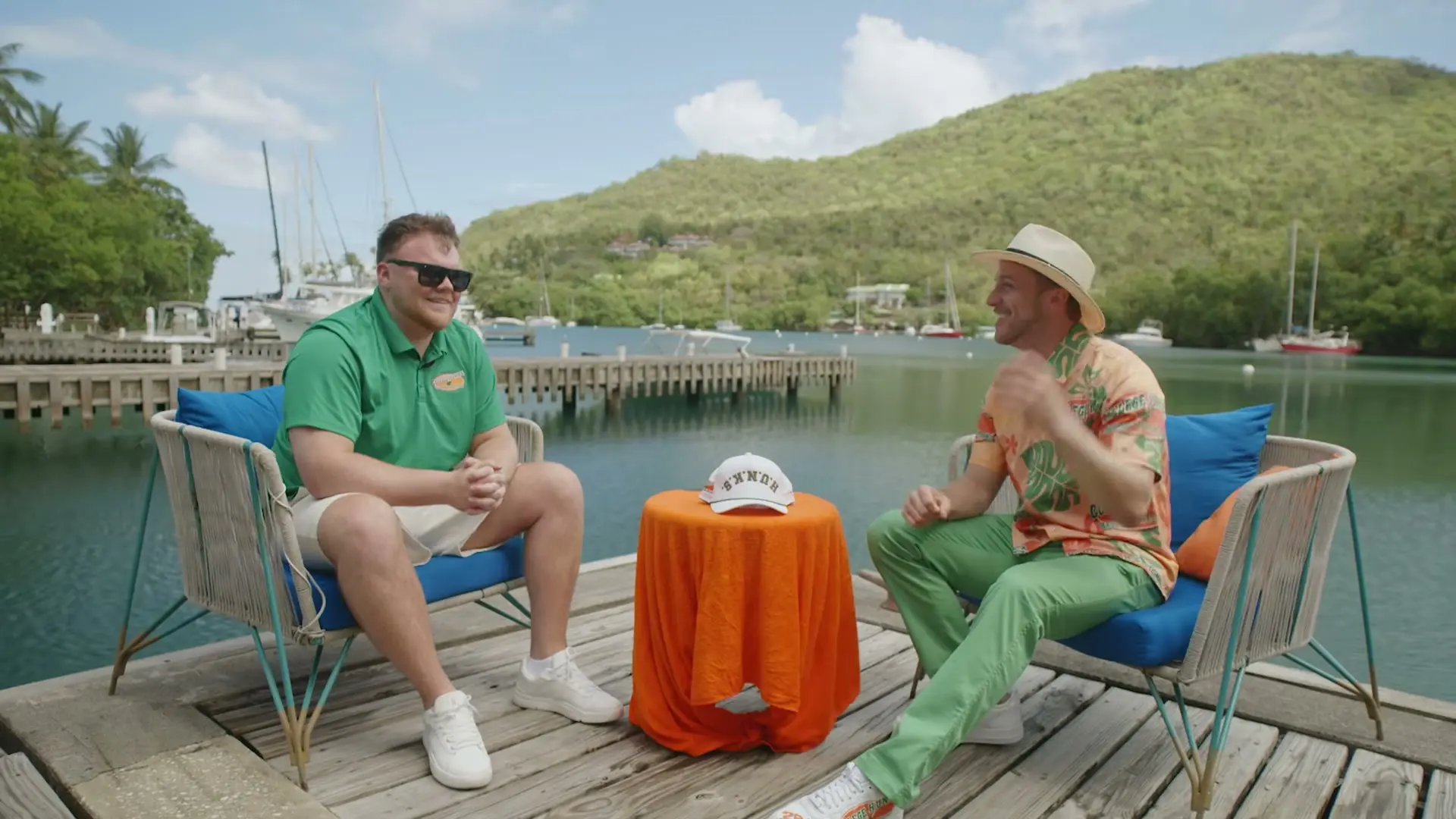
Co-founder Nick Friedman introduces him on the newest episode of Hunks Talking Junk as the youngest franchise owner in the College HUNKS organization. They recorded it on a dock in St. Lucia during the brand’s Raise the Bar reward trip, and Jack spends most of it on the unglamorous parts: going from everybody’s buddy to everybody’s boss, what golf taught him about blame, and how he got a bank to say yes.
Who is Jack Tonnessen?
Jack Tonnessen is the College HUNKS franchise owner in Germantown, Wisconsin, a 23-year-old who worked his way from the warehouse to the trucks to operations manager before buying the location. He was a serious high school golfer with plans to play in college. He started on a regular business degree, decided most of the answers he needed were already on his phone, and chose the business he was already working in.
The market he runs is not a big city. He describes it as flat roads and small towns, some with a stoplight and some with only a stop sign, with lake houses and trailer parks in the same service area. That shapes how he builds the brand. Online marketing and pay-per-click ads (the paid search listings at the top of Google) are part of it, along with yard signs, repeat and referral outreach, and cold calls to realtors and local businesses. Nick calls it being the mayor of your market.
Jack’s own version is more personal. He teaches his crews to let the 90-year-old client who has nobody else to talk to finish her story, even when they are watching the clock, because she is going to tell that story to other people too. He also refuses to turn down the hard jobs. Competitors in his area will not move pianos, and his read is that they just handed him every customer who owns one.
How did Jack go from warehouse worker to franchise owner?
He got there by keeping score, and by being ready when the owner decided to sell. As a wingman (the crew member who works alongside the truck captain), he and his captain, James, refreshed the location’s dashboard all day to make sure their revenue, average job size, Net Promoter Score and review count beat every other junk crew. Jack grew up as a competitive athlete, and the brand’s numbers are easy to track, so he treated it like a game he intended to win.
He is candid that ownership was never a plan from day one. His confidence in it grew a few percent at a time. Maybe 3% on some days, 10% after a year, 30% the year after that, and never all the way to 100%. What moved it was an owner who told him it was possible and the company’s core values, especially Building Leaders, which he says were drilled into the team from his first week. He even sent Nick messages on social media while he was still a team member, promising they were going to be the best franchise in the system. Nick admits he wondered who the bold kid was.
Nick uses a baseball comparison for this path. Getting called up from the minors takes more than being good. You have to be the best in the minors, and there has to be an opening on the big league roster. Jack’s opening came when the prior owner wanted to transition out, and he thinks being ready made that decision easier for her. The same promote-from-within route runs through this series: Adrian and Austin Thomas went from the back of a truck to owning the North Columbus, Ohio franchise.
The harder shift came after the keys changed hands. Going from crew buddy to young boss meant showing his team the part of ownership they do not see. He talks about putting expensive trucks on the road every day with young crews, fielding 30 calls on a trip where everyone else left their phone at the hotel, and taking on far more risk than any employee does. His standard for his leads is simple, and he borrows it from the calls he used to make to the prior owner, Amy.
“Come to me with the solution… and even if it’s not the right solution, cool. But at least we’re talking the same language.”
Jack Tonnessen
Golf supplied the rest of his thinking. There is nobody else to blame on a golf course, and he applies the same extreme ownership rule to the business. Everyone plays in the same weather, and every mover works in the same housing market with the same mortgage rates. The one golf lesson he still repeats came from a coach who filmed his swing: your feel is not your real. Jack says he has had the same moment with his own financials, feeling like a month went better than it did until the report came back.
On culture, Jack’s answer got a big reaction. Nick said it might be the most profound definition of company culture he had heard.
“It’s fluid and it’s flowing and it’s different every day.”
Jack Tonnessen
The upside of that, in his view, is that a bad day at the shop is over the next morning, and everybody on the team gets a fresh shot at making it better.
How did Jack finance buying a College HUNKS franchise?
Jack financed the purchase with an SBA loan plus a very small seller note, and he did it without an outside investor or a cosigner. He brings this up because people at company reunions kept asking whether his parents came along or helped him buy the business. They did not. Both have separate careers and no interest in owning a company.
“I didn’t get an investment. I didn’t get a co-signer from anyone, but what I was fortunate enough to get was approved by the SBA.”
Jack Tonnessen
He credits two things for the approval: the lending climate for small business purchases was hot at the time, and the location already had a track record under the prior owner. He also admits that when the franchisor’s leadership team told him how much working capital to have on hand, he did not have it yet. He had a sense he would figure it out. His view of SBA financing is that the terms may not be the best, but it is a way in, and a way in is all a first-time buyer needs. Once the business is operating, he says, cheaper and less risky capital starts to open up.
That capital has since let him make a second bet. He and his fiance, a realtor, have started buying value-add real estate (houses that need work before they are worth more), flipping and refinancing houses with help from investors they met on jobs. He is clear that he only did it after building up savings from the company, because overextending is the mistake he sees most often.
Do you need business experience to own a College HUNKS franchise?
No. Prior business ownership and junk removal or moving experience are not required to become a College HUNKS franchise owner. Candidates need a minimum net worth of $200,000 and at least $75,000 in liquid capital, and every owner works with a franchise business coach and a marketing coach. This is an owner-operator model, so the person who buys the franchise is the person who runs it.
Jack is an unusual version of that profile. The brand recruits heavily from corporate America and the military, and plenty of owners look like Todd and Anne Smith, who left 25-year corporate careers for Asheville. Jack says he makes a point of asking owners who walked away from big salaries what that shift felt like, since he never had to make it. What he brought instead was a few years of learning the location from the inside and a support system he could call. His summary of the franchise ecosystem: there is an answer for any question you have, because hundreds of people have already done what you are doing, and it is usually one phone call to your coach or another owner.
When a coaching call once floated giving his tired crew weekends off, he pushed back. He ran the math on losing two days out of seven and said no, and he tells his crew he would rather work this hard now, before kids and bigger obligations. Scott Leffel’s move from corporate sales to owning in Dallas covers the same stretch from the other end of a career.
If you want the path Jack took, see which territories are open right now or read through how the business works.
Where to listen to this episode
The full episode is on Apple Podcasts, Spotify, and YouTube. New Hunks Talking Junk episodes drop every other Thursday, and the rest of the series lives with our other franchisee stories.
| Time | Chapter |
|---|---|
| 0:00 | Intro |
| 2:10 | Starting in the warehouse |
| 6:23 | Minor leagues to majors |
| 8:47 | From buddy to boss |
| 11:06 | Golf lessons for business |
| 18:33 | Your feel vs. your real |
| 20:43 | Extreme ownership mindset |
| 32:44 | Building a local brand |
| 36:39 | Culture is never static |
| 46:13 | Buying in with SBA |
More franchise owner stories from Hunks Talking Junk
Every episode in this series is a first-person account from someone who bought and runs a College HUNKS franchise, or who helped build the system.
- Todd and Anne Smith: corporate careers to Asheville owners, including how their crew moved 170 families after Hurricane Helene.
- Shelly Sun Berkowitz on what makes a good franchisee, from the founder who built BrightStar Care and now sits on the College HUNKS board.
- Scott Leffel: corporate job at 50 to Dallas owner, including the 18 months he went without a paycheck.
- Erica Fine: single mom to seven-zone owner in greater Chicagoland.
- Adrian and Austin Thomas: from the back of a truck to owning the franchise in North Columbus, Ohio.
- Erick Ramirez on scaling operations in Albuquerque.
Want the path he took?
Jack walked into a warehouse at 17 and walked out of an SBA closing as the owner of the same location. You do not need his head start to follow the model, but you do need to want to run the business yourself. Walk through the territory map, the investment, and the numbers for your zip code with the franchise team. Start a conversation, or look at how the business works and what it costs to open first.
This story reflects the experience of an individual franchise owner and is not a representation of the results any other franchisee will achieve. Financial information shared in this content is drawn from Item 19 of the 2026 CHHJ Franchising, L.L.C. Franchise Disclosure Document (Issuance Date: April 30, 2026, as amended August 26, 2026). See Item 19 for material assumptions, the underlying data set, and full required disclosures. Past performance does not guarantee future results. New franchisees may earn less.
This information is not an offer to sell or solicitation to buy a franchise. A franchise offering can only be made through the delivery of a Franchise Disclosure Document. Certain states regulate the offer and sale of franchises; if you are a resident of one of these states, we will not offer you a franchise unless we have complied with applicable pre-sale registration and disclosure requirements in your state.
College Hunks Hauling Junk®, College Hunks Moving®, and the H.U.N.K.S logo are registered trademarks of CHHJ Franchising, L.L.C. © 2026 CHHJ Franchising, L.L.C. All rights reserved.

Twenty minutes with our team.
The model, the live territory map, and the unit economics for your market. No script, no pressure.
Qualifying veterans and first responders receive a discount on the initial franchise fee.
Could this be your story?
Book a call with the franchise development team. They’ll walk you through the model, the live territory map, and the unit economics for your market.
More from the newsroom.
Hand-picked from the same category. All stories →
-
Brady Wright: IU Student to Bloomington College HUNKS Owner
IU student Brady Wright signed a College HUNKS franchise to open in Bloomington, Indiana, before graduating. How he got there and what he plans to build.
-
Meet Montez Miles: From Helper to College HUNKS Owner in Indianapolis
Montez Miles worked his way up from helper to operations manager at another mover. Now he’s bringing College HUNKS junk removal and moving to Indianapolis.
-
8 Self-Employment Ideas After 50 for 2026
Eight self-employment ideas for experienced managers over 50, compared by capital, time to first customer and fit, from consulting to a franchise.