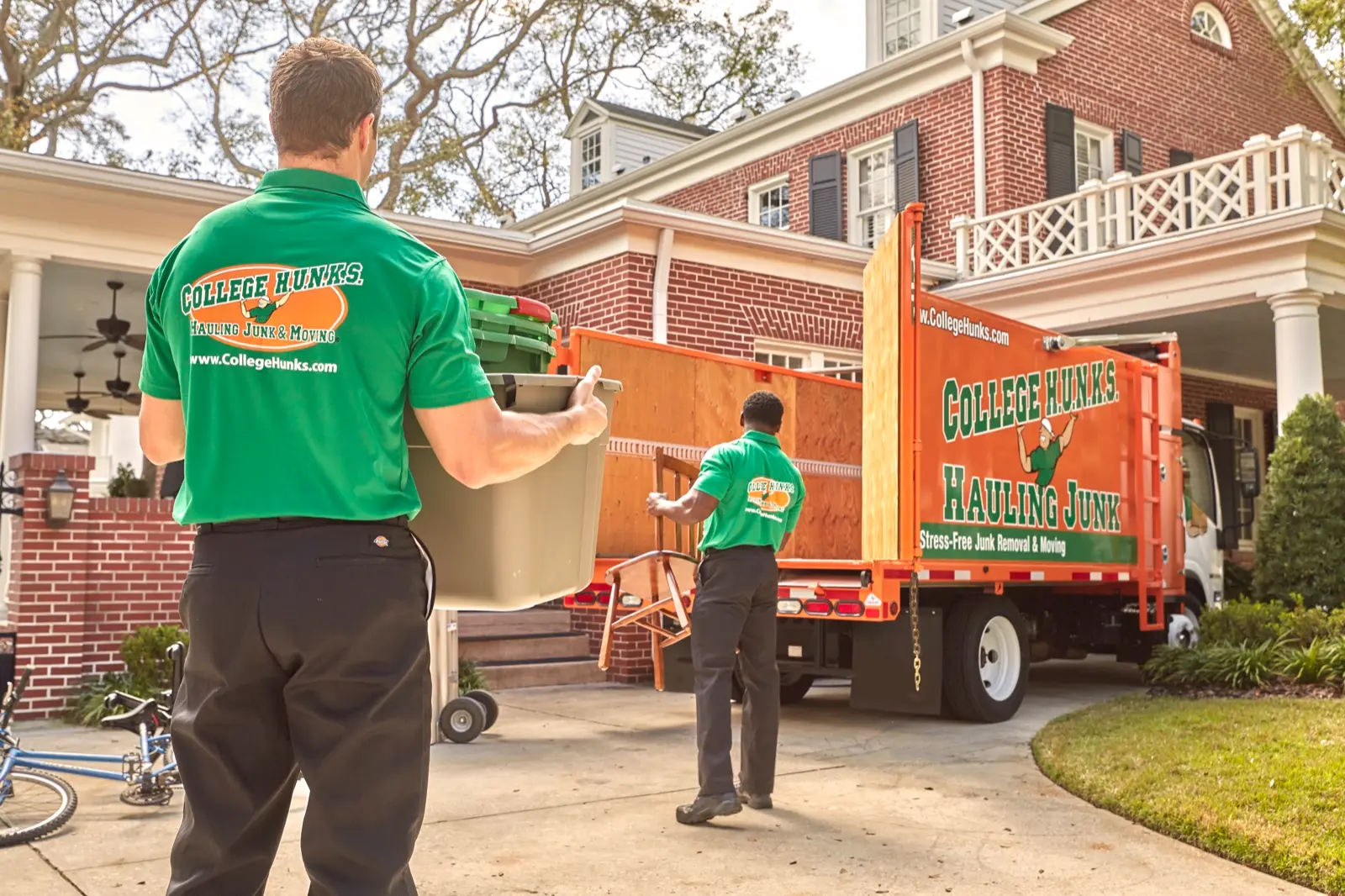
To start a box truck business, pick the lane first (junk removal, moving or freight), then form the company, buy a truck at the right weight class, register it with a USDOT number where required, insure it and line up steady work before the first payment comes due. Junk removal and moving let you set the price; freight usually does not.
Hauling junk, moving households and delivering freight are different businesses that happen to share a vehicle, so decide what the truck will carry before you buy it. That order matters because a truck parked in the driveway costs the same every month as one that runs full. It is also why College Hunks Hauling Junk® and College Hunks Moving® are built as a franchise around booked demand instead of a single truck waiting for the phone to ring. If junk is the cargo you pick, here’s how College HUNKS puts that truck to work.
What is a box truck business, and which kind are you starting?
A box truck business earns money moving goods in an enclosed straight truck, usually 16 to 26 feet long, and the lane you choose decides who books the work and who sets the price.
| Lane | Who books the work | Who sets the price |
|---|---|---|
| Freight and delivery | Brokers, load boards and delivery networks | Mostly the broker or network |
| Moving | Homeowners, renters, property managers, employers | You, by the hour or by estimate |
| Junk removal | Homeowners, landlords, realtors, contractors | You, by volume |
Moving and junk removal put the price in your hands, and they are the two lanes College HUNKS is built on: a junk truck and a moving truck under one brand, in one territory, on one technology stack, with jobs booked by a national Sales & Loyalty Center. The catch in both lanes, for anyone going it alone, is that you become the marketing department.
How do you start a box truck business, step by step?
Starting a box truck business takes seven steps, and the first and last decide whether the other five pay off.
- Pick the lane. Junk removal, moving or freight. Each one changes the truck, the permits and the customer.
- Write a plan with real demand in it. Who books you in the first 90 days, and how often. Our junk removal business plan guide covers the market analysis a lender will actually read.
- Form the company. An LLC or corporation, an EIN, a business bank account and bookkeeping from day one.
- Get the truck at the right weight class. The gross vehicle weight rating on the door sticker, not the length, sets your license rules.
- Register and permit it. A USDOT number where required, state registration, local business license and any dump permits.
- Insure it before the first job. Commercial auto, general liability, and workers compensation as your state requires once you hire help. Our guide to insurance for a hauling business explains the gaps that catch new owners.
- Build demand before you need it. Local search, reviews, referral partners and commercial accounts. Keeping a truck full takes marketing every week, long after launch day.
Do you need a CDL to start a box truck business?
You do not usually need a commercial driver’s license for a box truck rated at 26,000 pounds gross vehicle weight or less. Federal rules require a Class B CDL once a single vehicle’s weight rating or actual loaded weight reaches 26,001 pounds, whichever is greater (49 CFR 383.5). Hauling placarded hazardous materials requires a CDL at any weight, and some states add their own rules.
| Requirement | When it applies |
|---|---|
| Class B CDL | Single vehicle rated or loaded at 26,001 pounds or more |
| USDOT number | Commercial vehicles over 10,000 pounds crossing state lines, plus many in-state carriers depending on the state |
| Interstate operating authority | For-hire carriers moving household goods or regulated freight across state lines |
| State household goods permit | Many states, for moves that stay in-state |
| Business license and dump permits | Many cities, and any hauler using a transfer station or landfill |
Check the rating before you sign for a truck, not after. The permit side for haulers is covered in detail in what licenses a junk removal business actually needs.
How much money do you need to start a box truck business?
How much money you need depends mostly on how you get the truck. Buying outright, financing new, leasing or buying used can move your starting cash by tens of thousands of dollars before insurance, equipment and marketing enter the picture.
For a benchmark where every line is disclosed, a College HUNKS franchise with junk removal and moving in one Zone runs $193,100 to $345,500 in total estimated initial investment, including three months of working capital (2026 FDD, Item 7). The full investment breakdown shows each line, equipment included.
Whichever route you take, budget working capital honestly. A new truck rarely has a full calendar in month one, and the payment comes due either way.
Is a box truck business profitable, and how much can you make?
A box truck business is profitable when the truck stays busy at a price that covers everything it costs to keep on the road, so there is no single honest earnings number for an independent owner. Results swing on three things: how many days a week the truck earns, whether you set the rate or accept one, and discipline on repairs, fuel and insurance.
If you want documented figures instead of forum guesses, Item 19 of the College HUNKS Franchise Disclosure Document reports gross sales and EBITDA by how long locations have been open. You can see what franchisees actually earn with the context the FDD requires, and our honest look at junk removal economics breaks down where the margin goes.
What do new box truck owners get wrong?
Most new box truck owners buy the truck first and build the business around it second, and nearly every common mistake traces back to that order.
- Buying a truck rated over 26,000 pounds and discovering the CDL requirement afterward
- Pricing insurance after signing for the truck, then finding the premium breaks the budget
- Counting on one source of work, whether a broker, a network or a single contract
- Skipping a maintenance reserve, so the first major repair becomes a cash crisis
- Working solo, with no way to take a second job the same day
Most of that list comes down to demand and systems, the part a franchise is built to solve.
Why choose a College HUNKS franchise over a DIY box truck business?
A College HUNKS owner opens with a national Sales & Loyalty Center that books jobs and routes them by zip code, a brand with about $30 million a year in national media exposure, and two dedicated coaches from day one, while an independent owner builds demand one job at a time.
| Independent box truck business | College HUNKS franchise | |
|---|---|---|
| Who books the jobs | You, through ads, search and referrals | A national Sales & Loyalty Center books jobs and routes them by zip code |
| Brand customers recognize | Built from zero, one review at a time | About $30M a year in national media exposure, with past appearances on Shark Tank and Undercover Boss |
| Revenue lines | Usually one service per truck | Junk removal and moving under one brand |
| Commercial work | You chase each account | National Accounts and strategic partnerships |
| Coaching | Whatever you can find online | A Marketing Coach and a Franchise Business Coach |
| Proof before you commit | Forums and guesswork | 159 franchised outlets and Item 19 data in the FDD |
Ask the franchise development team what the Sales & Loyalty Center books in a market like yours.
The bigger shift is the job itself. A box truck owner drives the truck. A College HUNKS owner leads a team of 8 to 10 people per zone and adds trucks as each service’s booked work grows, which is how the two-in-one model works. That is why about 70% of our franchisees own more than one territory, and why multi-unit ownership is the path most owners grow into. The coaching side is laid out in the training and support owners get.
Should you start independent or step into a system?
Start independent if you want to set every rule yourself and you already have steady work lined up. Step into a system if buying a truck is the easy part for you and building the demand to fill it is the part you would rather not do alone. Already running a hauling or moving truck? Converting your business to a franchise comes with up to $30,000 off the initial fees when you convert both concepts.
If you are weighing whether a College Hunks Hauling Junk® franchise fits your goals, talk to the franchise development team and see if your market is still open. We read every inquiry, and there is no pressure, just answers.
Disclosures
Financial information shared in this content is drawn from Item 19 of the 2026 CHHJ Franchising, L.L.C. Franchise Disclosure Document (Issuance Date: April 30, 2026, as amended August 26, 2026). See Item 19 for material assumptions, the underlying data set, and full required disclosures. Past performance does not guarantee future results. New franchisees may earn less.
This information is not an offer to sell or solicitation to buy a franchise. A franchise offering can only be made through the delivery of a Franchise Disclosure Document. Certain states regulate the offer and sale of franchises; if you are a resident of one of these states, we will not offer you a franchise unless we have complied with applicable pre-sale registration and disclosure requirements in your state.
College Hunks Hauling Junk®, College Hunks Moving®, and the H.U.N.K.S logo are registered trademarks of CHHJ Franchising, L.L.C. © 2026 CHHJ Franchising, L.L.C. All rights reserved.

Twenty minutes with our team.
The model, the live territory map, and the unit economics for your market. No script, no pressure.
Qualifying veterans and first responders receive a discount on the initial franchise fee.
Could this be your story?
Book a call with the franchise development team. They’ll walk you through the model, the live territory map, and the unit economics for your market.
More from the newsroom.
Hand-picked from the same category. All stories →
-
How to Become a Franchise Owner in 9 Steps (2026)
How to become a franchise owner in 9 steps: qualify, fund, pick a brand, study the FDD, check owners, sign, train and open.
-
Initial Franchise Fee: What It Covers and Costs
The initial franchise fee typically runs $20,000 to $50,000. See what it covers, what it doesn’t, and how College HUNKS fees compare in the FDD.
-
What Is a Conversion Franchise? (2026 Guide)
What is a conversion franchise? How conversion franchising works, its pros and cons, and how junk and moving operators convert to College HUNKS.