Yes, junk removal can be a profitable business, and the reason is structural: the work carries low material costs, gets paid at the point of service, and prices by volume rather than by the hour. What separates the operations that do well from the ones that grind is rarely pricing. It is route density, disposal strategy, and how much of the calendar stays booked. Here is an honest look at where the margin actually comes from, and where it quietly disappears.
Why the Economics Work in the First Place
Junk removal has an unusual cost structure for a home service. There is no inventory to carry, no parts to stock, and no materials to mark up. What you sell is labor, a truck, and the willingness to handle things other people do not want to handle. Customers pay when the job is done, so there is no receivables cycle to finance, which is a meaningful advantage over trades that invoice and wait.
Pricing is by volume, usually as a fraction of the truck. That matters more than it first appears. An hourly business is capped by the clock, but a volume business rewards a crew that works efficiently, because filling the truck faster means another job the same day rather than the same money spread over more hours.
The barrier to entry is also genuinely low, and that cuts both ways. A truck and a license gets someone into the market, which means most metros have a long tail of one-truck operators. Competing on price against that tail is a losing game. Competing on reliability, appearance, and how fast you answer the phone is not, and that is where an established brand earns its keep.
Where the Margin Actually Goes
Four line items do most of the damage, and only one of them is obvious.
Disposal. Tipping fees are the single largest variable cost in the business, and they are rising in most markets. Every load has a disposal cost attached, and operators who sort donation and recycling material on the truck rather than sending everything to the landfill pay measurably less per job. This is also the one cost that scales directly with the work, so it never dilutes with volume the way overhead does.
Unbilled drive time. The customer pays for the job, not for the trip to the transfer station afterward. The queue, the tipping, and the drive back are all unpaid, and in a spread-out service area that round trip can consume more of the day than the job itself. Route density is not a nice-to-have here. It is the difference between three jobs a day and five.
Labor. Crew is the product, and good crew is not cheap. Turnover is the hidden version of this cost, because every departure means recruiting, training, and a stretch of slower, less careful work while the new person learns. Owners who pay slightly above market and keep people tend to run better days than owners who chase the lowest wage.
Getting the phone to ring. Customer acquisition is the cost most first-year owners underestimate by the widest margin. Junk removal is a low-frequency purchase, so there is limited repeat business on the residential side to amortize that spend against. Commercial and property management accounts are the exception, and they are worth pursuing precisely because they book repeatedly.
What an Owner Actually Takes Home
This is the question behind the question, and it deserves a straight answer about how the math is structured rather than a number pulled from the air.
Owner compensation in this business is a function of three things: how many trucks are running, how much of the work the owner personally performs, and what is left after disposal, labor, vehicle, insurance, and marketing. A single-truck owner-operator who rides along is effectively paying themselves a wage plus whatever the business clears. The step change happens when a second and third truck let the owner step off the truck and manage the operation, because at that point the business is producing without consuming all of the owner’s hours.
For a franchised comparison, across all College Hunks Hauling Junk® franchised locations reporting in the 2026 Franchise Disclosure Document, average gross revenue was $1,554,610 across 144 locations, per Item 19. That is a top-line figure for established locations running two service lines, not owner compensation and not a first-year number. Item 19 sets out the material assumptions and the underlying data set, and it is the only place any brand can responsibly present figures like these. If a payback period or an owner income figure comes up while you are evaluating any franchise, the useful question is where it appears in that brand’s Item 19.
Why Single-Service Operators Hit a Ceiling
Junk removal demand is real but uneven. Spring cleanouts and summer moving season carry most markets, and the winter weeks are noticeably quieter outside the warmest climates. An operator with one service line absorbs that swing directly. The trucks and the crew are fixed costs that do not care what month it is.
That seasonality is the practical ceiling on a junk-only operation. It is not that the work is unprofitable in the strong months. It is that the weak months have to be carried by the strong ones, and that shapes everything from hiring to how much equipment an owner is willing to finance.
How a Second Revenue Line Changes the Math
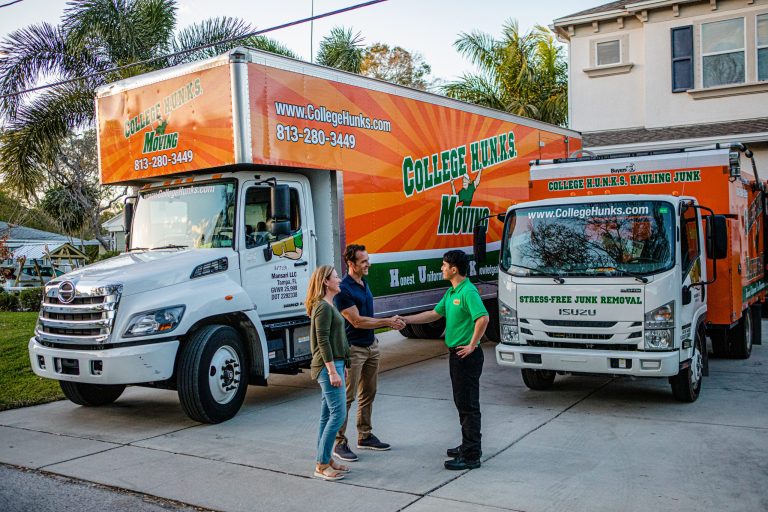
The College Hunks model pairs College Hunks Hauling Junk® with College Hunks Moving® under one brand, one franchise fee, and one shared back office. The practical effect is that the same fixed costs serve two kinds of demand, and the two do not peak and trough in the same pattern. A crew that would have been idle in a slow junk week is on a move instead.
It also changes the customer relationship. A household clearing out a garage this month is often a household moving next year, and a brand that does both gets both jobs rather than handing one to somebody else. You can read more about how the two-in-one model works, or see the fuller picture of what franchisees report in Item 19.
Is It a Good Business to Be In Right Now?
The underlying demand drivers are steady and largely demographic. People downsize, estates get cleared, households move, landlords turn over units, and businesses clear out offices. None of that is discretionary in the way a luxury purchase is, and none of it can be done remotely or offshored. It is also stubbornly resistant to automation, which is not something you can say about many service categories at the moment.
What has changed is the competitive floor. Customers now expect same-day or next-day availability, upfront pricing, and a crew that looks the part. Meeting that expectation as a single operator is possible but demanding. It is the main reason people who start independently often end up looking at franchising a year or two in, and it is why converting an existing junk business to a franchise is a well-worn path rather than an unusual one.
If you are earlier than that and still weighing the two routes, how to start a junk removal business walks through the independent setup step by step, and an honest comparison of junk removal franchises lays the brands side by side.
Frequently asked questions
What makes one junk removal business more profitable than another?
Route density and disposal strategy, more than pricing. Two operators charging the same rates can have very different days if one is driving across a sprawling service area to a distant transfer station and the other has tight routes and a closer disposal relationship. Sorting donation and recycling material on the truck also reduces what goes to the landfill, and repeat commercial accounts fill the calendar more evenly than one-off residential jobs.
Is junk removal a seasonal business?
It runs year-round, but volume is not flat. Spring cleanouts and the summer moving season carry most markets, while winter weeks are quieter almost everywhere outside the warmest climates. Operators smooth that curve by building commercial and property management accounts, which book more predictably, or by adding a second service line so the same crew and trucks stay busy when junk volume dips.
Does adding moving services help a junk removal business?
It addresses the seasonality problem directly, because moving demand and junk removal demand do not peak at the same time. The same office, back office, and shared overhead serve both, so those fixed costs are spread across more working days. It also captures more of each customer relationship, since a household clearing a garage this year is often a household moving the next.
How many trucks does it take before the owner can step off the truck?
Most owners describe the shift happening somewhere around the second or third truck. With one truck the owner is usually part of the crew, which caps the business at their own hours. Adding capacity lets a lead crew member run day-to-day operations while the owner focuses on hiring, commercial accounts, and marketing, which is the point at which the business starts producing without consuming every one of the owner’s working hours.
Is junk removal harder to run than other home service businesses?
It is physically demanding and it lives or dies on crew quality, but the operational complexity is lower than trades that require licensed technicians, stocked parts, or permit-gated work. There is no inventory, customers pay at the point of service, and the skill barrier for a new crew member is training rather than certification. The trade-off is that the low barrier to entry means most markets have a crowded field, so reliability and presentation matter more than they would in a licensed trade.
Related reading
- What licenses and permits a junk removal business needs, including when a truck actually needs a CDL.
- How to write a junk removal business plan, the version a lender will actually read.
- How to build a junk removal pricing sheet, and what has to be built into the price.
- How to start a box truck business, the three lanes, CDL rules, and what a franchise changes about filling the truck.
Financial information shared in this content is drawn from Item 19 of the 2026 CHHJ Franchising, L.L.C. Franchise Disclosure Document (Issuance Date: April 30, 2026, as amended August 26, 2026). See Item 19 for material assumptions, the underlying data set, and full required disclosures. Past performance does not guarantee future results. New franchisees may earn less.
This information is not an offer to sell or solicitation to buy a franchise. A franchise offering can only be made through the delivery of a Franchise Disclosure Document. Certain states regulate the offer and sale of franchises; if you are a resident of one of these states, we will not offer you a franchise unless we have complied with applicable pre-sale registration and disclosure requirements in your state.
College Hunks Hauling Junk®, College Hunks Moving®, and the H.U.N.K.S logo are registered trademarks of CHHJ Franchising, L.L.C. © 2026 CHHJ Franchising, L.L.C. All rights reserved.

Twenty minutes with our team.
The model, the live territory map, and the unit economics for your market. No script, no pressure.
Qualifying veterans and first responders receive a discount on the initial franchise fee.
Could this be your story?
Book a call with the franchise development team. They’ll walk you through the model, the live territory map, and the unit economics for your market.
More from the newsroom.
Hand-picked from the same category. All stories →
-
Moving Company Marketing: How Movers Stay Booked
Moving company marketing that fills the calendar: trust signals, lead sources, estimate follow-up and seasonality, plus what a franchise takes on.
-
Costs of Operating a Franchise in 2026
The costs associated with operating a franchise fall into two streams: franchisor fees on gross sales, and the operating costs you carry anyway.
-
Moving Company License Requirements (2026)
What moving company license do you need? USDOT authority for interstate moves, state permits for local ones, plus the LLC, insurance and timeline steps.