Owning a fast food franchise can absolutely work, and it asks for more time and more
committed capital than most first-time buyers expect. The brand is rarely what decides the
outcome. What decides it is whether you can carry a year or more of site work and construction
before the first dollar arrives, and whether you want to run a high-headcount hourly operation once
the doors finally open. Both of those are knowable before you sign, and both are written down in
documents you are entitled to read.
What does owning a fast food franchise actually involve?
It involves building a small commercial building before it involves selling any food. You are
finding a site, negotiating a lease, clearing permits, managing a general contractor, passing
inspections, hiring and training a crew, and only then opening. The franchisor supplies the brand,
the system, and the specifications. You supply the capital and the eighteen months of patience.
That is not a criticism of the model. Plenty of people have built real wealth inside it. It is
simply a different job from the one most buyers picture when they imagine owning a restaurant.
How long before a fast food franchise opens?
Commonly six to twelve months, and longer when permitting or construction gets
complicated. Jack in the Box states on its own franchising site that it typically offers an
18-month term to open the doors of a first location, with extensions available for a fee. Zoom Room,
a fitness franchisor, publishes a similar breakdown from the other direction: brick-and-mortar
concepts usually take four to nine months, restaurants often six to twelve because of build-out and
permitting, and models with no customer-facing build can launch in 30 to 90 days.
The pattern in all of that is consistent. The months are not going into training or onboarding.
They are going into real estate and construction, and those are the parts of the timeline you
control least.
What does the money buy?
In a restaurant, most of the initial investment becomes leasehold improvements.
Hoods, walk-in coolers, grease traps, seating, a drive-thru lane. Those improvements live inside a
building you lease rather than own, which makes them difficult to recover if you decide to exit.
Compare that against a service franchise, where the largest capital line is vehicles and
equipment that hold a resale market. For reference, a College Hunks Hauling Junk® and
College Hunks Moving® franchise runs $193,100 to $345,500
in total initial investment for both concepts in one Zone, disclosed in Item 7. Neither number is
better in the abstract. They simply fail differently, and that is worth understanding before you
commit.
What does the day-to-day job look like?
A quick-service restaurant is a high-headcount hourly business running nights, weekends and
holidays. Recruiting, scheduling and retention are the job, and the counter does not close because
you have a family commitment. A service franchise is also a people business, but it runs on crews
and a route rather than a building with fixed hours.
Ask yourself honestly which of those two you actually want to run for the next ten years. That
question decides more outcomes than any brand comparison will.
What should you check before you sign anything?
Every answer that matters is already written down in the Franchise Disclosure Document. Ask for
it, then read these items in this order.
| Question | Where the answer lives |
|---|---|
| What will this really cost me to open? | Item 7, total initial investment |
| How long do I have, and how long will it take? | Item 11, obligations and time to open |
| What do I owe every month, forever? | Item 6, royalty and other recurring fees |
| Can someone else open nearby? | Item 12, territory and exclusivity |
| What do existing locations actually do? | Item 19, financial performance representation |
| Who has left, and why? | Item 20, outlet counts and franchisee contact list |
If a brand will not walk you through Item 19, or has no Item 19 at all, that is information too.
It is not disqualifying, and it does mean you are being asked to invest on faith.
When is a fast food franchise the right call?
When you have the capital to sit through a long build without stress, when you genuinely want to
operate a food business, and when you have a site or a developer relationship that shortens the
hardest part of the timeline. Those buyers do well. If none of those three describe you, the
category is fighting you before you open.
If you are in that second group, the honest next step is to look at what else clears your bar.
Our side-by-side on restaurant franchise alternatives puts opening timelines,
Item 7 investment and ongoing fees next to each other, and
the investment page breaks our own numbers down line by
line.
Keep reading
The rest of this comparison, one question at a time.
- Low Cost Restaurant Franchise: What Cheap Costs, why a low franchise fee is not a low investment
- Franchise With the Fastest Return on Investment, what you can compare before you sign
- How Long Does It Take to Open a Franchise?, the timeline from signing to opening
Talk it through with the franchise development team
If you are weighing a food franchise against a service franchise, we would rather give you the real numbers than a brochure. Talk to our Franchise Development team, or check whether a territory is still open in your market. Start with the side-by-side on restaurant franchise alternatives if you want the numbers first. We read every inquiry, and there is no pressure.
Disclosures
Financial information shared in this content is drawn from Item 19 of the 2026 CHHJ Franchising, L.L.C. Franchise Disclosure Document (Issuance Date: April 30, 2026, as amended August 26, 2026). See Item 19 for material assumptions, the underlying data set, and full required disclosures. Past performance does not guarantee future results. New franchisees may earn less.
This information is not an offer to sell or solicitation to buy a franchise. A franchise offering can only be made through the delivery of a Franchise Disclosure Document. Certain states regulate the offer and sale of franchises; if you are a resident of one of these states, we will not offer you a franchise unless we have complied with applicable pre-sale registration and disclosure requirements in your state.
College Hunks Hauling Junk®, College Hunks Moving®, and the H.U.N.K.S logo are registered trademarks of CHHJ Franchising, L.L.C. © 2026 CHHJ Franchising, L.L.C. All rights reserved.

Twenty minutes with our team.
The model, the live territory map, and the unit economics for your market. No script, no pressure.
Qualifying veterans and first responders receive a discount on the initial franchise fee.
Could this be your story?
Book a call with the franchise development team. They’ll walk you through the model, the live territory map, and the unit economics for your market.
More from the newsroom.
Hand-picked from the same category. All stories →
-
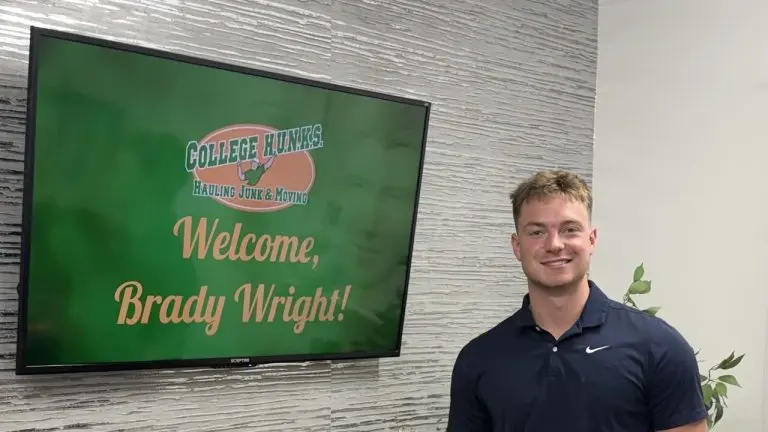
Brady Wright: IU Student to Bloomington College HUNKS Owner
IU student Brady Wright signed a College HUNKS franchise to open in Bloomington, Indiana, before graduating. How he got there and what he plans to build.
-
Meet Montez Miles: From Helper to College HUNKS Owner in Indianapolis
Montez Miles worked his way up from helper to operations manager at another mover. Now he’s bringing College HUNKS junk removal and moving to Indianapolis.
-
8 Self-Employment Ideas After 50 for 2026
Eight self-employment ideas for experienced managers over 50, compared by capital, time to first customer and fit, from consulting to a franchise.