Franchise leadership · Hunks Talking Junk
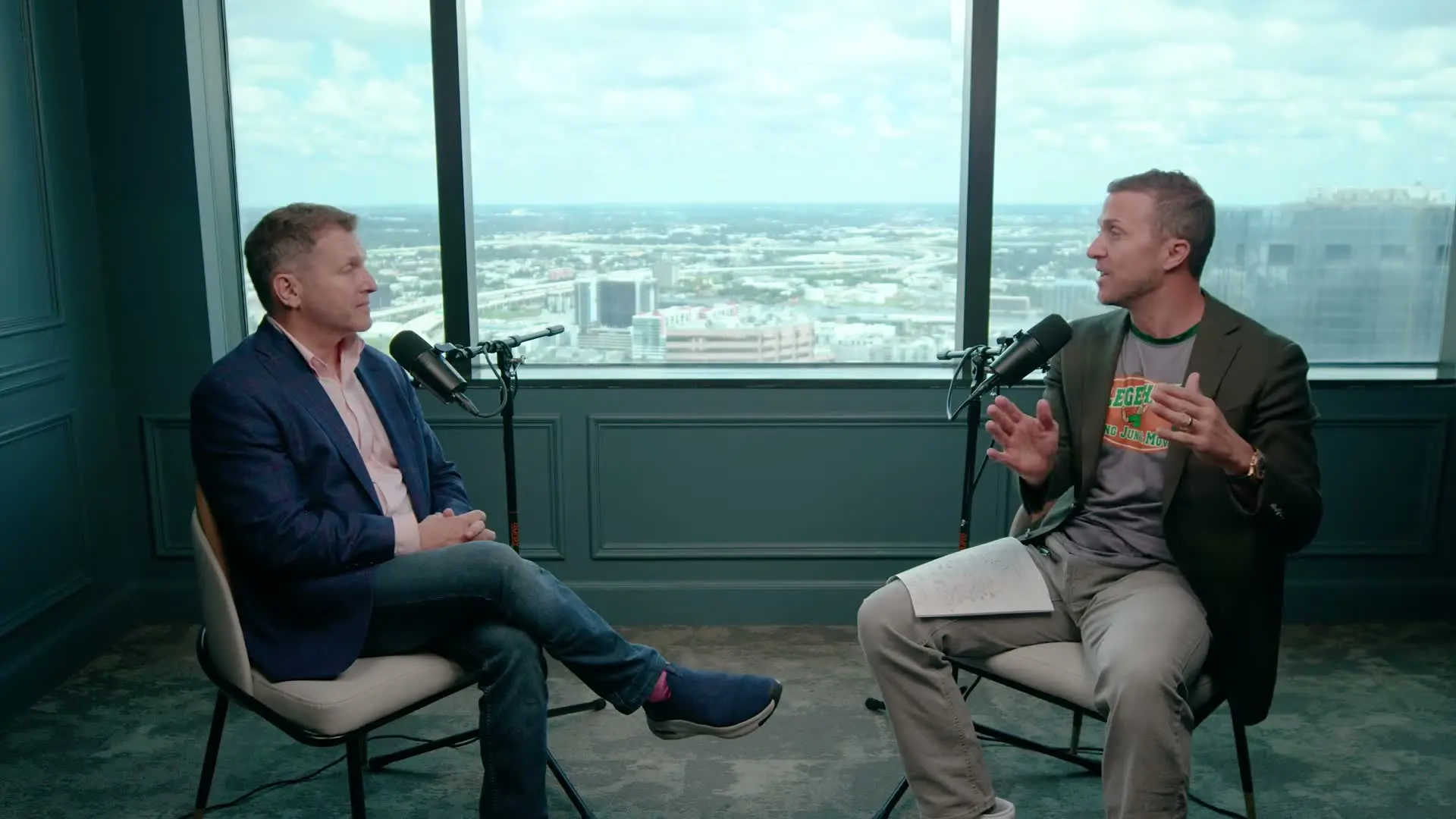
John DiJulius is the founder and Chief Revolution Officer of The DiJulius Group, a customer and employee experience consulting firm he started in 2006, and the founder of John Robert’s Spas in Cleveland. He sat down with College Hunks Hauling Junk® & College Hunks Moving® co-founder Nick Friedman for the newest episode of Hunks Talking Junk, and Nick opened with the question every service business should be asking: why does customer service matter more right now than it ever has?
John’s answer gets practical fast. He walks through how repeat and referral customers differ from the ones you pay to reach, what to hire for on a customer-facing team, and what to do in the first minute after service goes wrong. If you are weighing a service franchise, this episode covers the part of the job a spreadsheet can’t show you: how the crew in someone’s home decides whether that customer ever calls you again.
Who is John DiJulius?
John DiJulius is a customer experience consultant and the best-selling author of six books, including The Customer Service Revolution and The Relationship Economy. His firm has worked with clients including The Ritz-Carlton, Starbucks, Lexus, and Chick-fil-A. Many of the examples on this episode come from his own salon and spa business in Cleveland, so the advice comes with an owner’s view of the front desk.
Nick has followed John’s work for nearly two decades. About 15 years ago he heard John speak and came home with an idea College HUNKS turned into its own Always and Never list, which comes up later in the episode. Nick credits that talk with shaping how the business thinks about service.
Why does customer service matter more now?
Customer service matters more now because, in John DiJulius’s view, customers are paying more and getting less, and technology alone can’t build the connection that brings them back. He says people leave a business sooner than they used to, often after one bad experience. Meanwhile a competitor can copy your app. Strip the color out of Uber and Lyft, he says, and you wouldn’t know which one you were using.
“Technology by itself is the easiest thing to replicate, but it doesn’t create an emotional connection.”
John DiJulius, founder and Chief Revolution Officer, The DiJulius Group
That point hits differently in a business like College HUNKS. Nick describes sending crews into people’s homes at a moment of real stress, to carry their heaviest and most prized possessions up and down stairways. There is no dining room for a manager to walk. John’s advice for that setting is to be in what he calls the certainty business, which means overcommunicating before the crew arrives so the customer always knows what happens next.
What is the difference between bought and earned sales?
Bought sales come from customers you paid to reach, and earned sales come from repeat customers and referrals. John’s formula for earned sales growth is repeat plus referrals, divided by overall sales, and he says a business should know that number by location and by individual.
The difference shows up in how the customer shops. Someone who googled you is comparing you to four other companies and looking for the best deal. Someone who was told by three people to call you isn’t comparing you to anyone, so the sales cycle is shorter and price matters less. John’s goal is to create the kind of fan who won’t let a friend hire anyone else.
“I have some businesses that I’m like, ‘Dude, you have to use this.’ They are the best. That’s what you want to create.”
John DiJulius
Nick explains why that matters in hauling and moving. College HUNKS isn’t a subscription, and most people only move every few years, so the next job depends on being the name that comes up when a neighbor or friend needs help. If you are doing due diligence on any service brand, ask existing owners how they track repeat and referral customers. The franchise due diligence guide covers how those validation calls (conversations with current owners before you sign) work.
How do you keep service consistent across a franchise system?
You keep service consistent across locations by writing the standards down and repeating them until the team can finish your sentences, and John says that work starts with the leader. He warns about what he calls employee roulette, where the experience depends on which employee a customer happens to get. In a franchise system he calls it franchisee roulette. A customer who has one bad visit rarely blames that one location. They blame the brand.
That is worth noticing as a buyer, because brand standards protect your reputation too. The customer in your market doesn’t separate your location from one in another state.
John’s tool is a Customer Bill of Rights. Nick’s version at College HUNKS is the Always and Never list, a one-page list of what the team always does and never does, modeled on John’s and added to over the years. A few examples from the episode:
- Never point, always show. Send the link or track down the answer yourself instead of telling a customer where to look.
- Never say no. Figure out what the customer is really asking for. John’s Sandals Resorts example is the guest who arrives before the room is ready: what they want is to start the vacation, so the team takes the luggage and points them to the pool.
- Never overshare. Customers don’t need to hear about internal mix-ups. They need it made right.
Nick gives the College HUNKS version of that last one, for the moment on a job when a customer heard something different from what the crew was told:
“We never say they. We say we.”
Nick Friedman, co-founder, College HUNKS
Repetition does the rest. John recommends short video reminders, about 90 seconds, on things the team already knows, a practice called microlearning, and Nick describes the leader’s job as chief repetition officer. John also says service starts at the top, which matches what IFA CEO Matt Haller said about checking the mirror before you blame anyone else.
What should you hire for on a customer-facing team?
You should hire for the traits you can’t teach and train the rest, according to John DiJulius. He lists 10 service aptitude skills and says six of them can be trained, including empathy and curiosity, which surprises people. Traits like friendliness and optimism are the ones he screens for in the interview. One of his interview questions asks what a candidate likes to do with free time. He doesn’t care about the answer. He wants to see whether they get excited talking about their favorite thing, because if they don’t, they won’t get excited about helping your customers.
For curiosity, he teaches a simple prompt called FORD: family, occupation, recreation, dreams. Team members who struggle with small talk get four places to start, and the details they remember give them something to follow up on next time.
For a franchise owner, this is much of the job. When the talk turns to employees who fall short, John points back at the leader: if someone was rushed out on a job without proper training, or was a mistake hire nobody addressed, that is on the business. Building Leaders is one of the College HUNKS core values, and the Thomas brothers, who went from riding in the truck to owning a location, show what developing people from the crew up can look like.
How should a business respond when service goes wrong?
A business should respond to a service failure by letting the customer finish, owning the problem, and fixing it, and John trains that with the acronym LEAST: listen, empathize, apologize, solve, and thank. Listening means no interrupting and no defending. The apology can be a no-fault apology. He also says to find the places you most often drop the ball, build systems to cut how often they happen, and train the team for what to do when they still do.
A few more ideas from this part of the conversation:
- Match the fix to the inconvenience. A 10-minute wait gets a sincere thank you. A customer who drove 45 minutes for nothing gets more, and John’s team has the room to decide on the spot.
- Own what you didn’t cause. Weather, traffic, and third-party vendors may be outside your control, but John says they are still your problem, because you chose the vendor and you can build in a follow-up.
- Keep it calm in public. On social media John says to skip the defense, apologize for the experience, and move the conversation offline. Handled well, a complaint can turn into a customer telling people how well you handled it.
- Trust people by default. He would rather give most customers the benefit of the doubt than treat everyone like the rare person trying to take advantage.
Nick adds a phrase from John’s teaching, ducks on a pond: calm on the surface, even if the crew is paddling hard underneath. Todd and Anne Smith’s Asheville crew after Hurricane Helene is what that kind of steadiness looks like when the stakes are real.
What is a daymaker culture?
A daymaker culture is one that gives employees room to do something unexpected for a customer, then celebrates them for it. John’s point is that the person who makes someone’s day often feels the best about it, and that people who go home with that kind of story tend to like their jobs. He shares the example of a spa guest who mentions her mother has died: in his business, she doesn’t pay.
Nick’s version of empathy training is showing the whole team a day in the life of a customer, because a move can mean a new house, a divorce, or a death in the family. Jack Tonnessen’s episode on buying the Germantown location where he started covers the same culture question from an owner’s chair.
John closes with the question his phone shows him at 10 p.m. every night:
“How many people had a better day as a result of coming in contact with me?”
John DiJulius
Do you need business experience to own a College HUNKS franchise?
No. Prior business ownership and junk removal or moving experience are not required to become a College HUNKS franchise owner. Candidates need a minimum net worth of $200,000 and at least $75,000 in liquid capital, and every owner works with a franchise business coach and a marketing coach. It is an owner-operator model, so the person who buys the franchise runs it, and that includes setting the service standard John talks about here.
Most College HUNKS owners come from corporate careers or the military, and the brand looks for leaders who want to build a team. If you want to see where the model could work for you, check which territories are open right now or read through how the business works.
Where to listen to this episode
The full episode is on Apple Podcasts, Spotify, and YouTube. New Hunks Talking Junk episodes drop every other Thursday, and the rest of the series lives with our other franchisee stories. You can find more from John at thedijuliusgroup.com.
| Time | Chapter |
|---|---|
| 0:00 | Cold Open and Introduction |
| 1:16 | Why Service Matters Now |
| 5:34 | Building Service at Scale |
| 11:29 | Customer Bill of Rights |
| 16:06 | Earned Sales Growth |
| 20:58 | Service Traits to Hire For |
| 27:03 | Recovering From Service Mistakes |
| 34:08 | Handling Social Media Complaints |
| 38:36 | Staying Calm Under Pressure |
| 45:54 | Building a Daymaker Culture |
More franchise owner stories from Hunks Talking Junk
Every episode in this series is a first-person account from someone who bought and runs a College HUNKS franchise, or who helped build franchising itself.
- Matt Haller on the biggest new franchisee mistake, from the President and CEO of the International Franchise Association.
- Jack Tonnessen: warehouse worker to Germantown owner, financed with an SBA loan and no cosigner.
- Todd and Anne Smith: corporate careers to Asheville owners, including how their crew moved 170 families after Hurricane Helene.
- Shelly Sun Berkowitz on what makes a good franchisee, from the BrightStar Care founder and past IFA chair who now sits on the College HUNKS board.
- Scott Leffel: corporate job at 50 to Dallas owner, including the 18 months he went without a paycheck.
- Erica Fine: single mom to seven-zone owner in greater Chicagoland.
- Adrian and Austin Thomas: from the back of a truck to owning the franchise in North Columbus, Ohio.
- Erick Ramirez on scaling operations in Albuquerque.
Ready to see what you would be building?
A service reputation gets built one job at a time, by a crew you hire and train. If that sounds like work you would want to lead, the franchise team will walk you through the territory map and the investment, and answer every question on your list. Start a conversation, or look at how the business works and what it costs to open first.
John DiJulius is the founder and Chief Revolution Officer of The DiJulius Group and is not a College HUNKS franchise owner. Examples he shares come from his own businesses and consulting work and are not a representation of College HUNKS franchise performance.
Financial information shared in this content is drawn from Item 19 of the 2026 CHHJ Franchising, L.L.C. Franchise Disclosure Document (Issuance Date: April 30, 2026, as amended August 26, 2026). See Item 19 for material assumptions, the underlying data set, and full required disclosures. Past performance does not guarantee future results. New franchisees may earn less.
This information is not an offer to sell or solicitation to buy a franchise. A franchise offering can only be made through the delivery of a Franchise Disclosure Document. Certain states regulate the offer and sale of franchises; if you are a resident of one of these states, we will not offer you a franchise unless we have complied with applicable pre-sale registration and disclosure requirements in your state.
College Hunks Hauling Junk®, College Hunks Moving®, and the H.U.N.K.S logo are registered trademarks of CHHJ Franchising, L.L.C. © 2026 CHHJ Franchising, L.L.C. All rights reserved.

Twenty minutes with our team.
The model, the live territory map, and the unit economics for your market. No script, no pressure.
Qualifying veterans and first responders receive a discount on the initial franchise fee.
Could this be your story?
Book a call with the franchise development team. They’ll walk you through the model, the live territory map, and the unit economics for your market.
More from the newsroom.
Hand-picked from the same category. All stories →
-
What Are the Advantages of Operating a Franchise?
The advantages of operating a franchise, from proven systems to brand recognition, and where to verify each one in the FDD before you sign.
-
Franchise vs Chain: What’s the Difference? (2026)
Franchise vs chain: a chain is many locations under one brand, a franchise is who owns them. Here is what that means if you want to buy in.
-
Franchisor vs Franchisee: Who Does What?
Franchisor vs franchisee: who owns the brand, who runs the business, who pays whom, and how the FDD draws the line between the two roles.